‘Twas the Season to be Celebrated – But Watch What you Say, Apparently

We can respect people even if we don’t agree with their policies, viewpoints or personal preferences, as long as their values match our own.  Any religion that builds paths of good intentions and love on my values of truth, tolerance, integrity, fairness, and justice, I can appreciate.

The foundation of major diverse religions are based on its various historic treasures and teachings.  For example, for Christians, their bible of behavior is the actual Bible.

The Bible has beautiful psalms and quotes. I admit to often finding myself flummoxed, however, by the followers of the literal Bible. I stare with concern at the Bible in my hotel drawer…why this particular historic foundation and not another? What passage will be lifted out of context? I speed up my walking past the street corners where people with Bibles in hands hawk that we sinners can’t be saved because we are not on their path.

Enter Christmas, the socially accepted birthday of Jesus Christ, and season’s greetings.

There are many religious and social holidays during the winter season, and Christmas and New Year are mine. I love all things Christmas and cheerfully shout out both “Merry Christmas” and “Happy Holidays” to folks, with thoughtfulness as to which holiday the folks are actually celebrating. I guess I could shout out “Goodwill and peace to all!” to everyone, as a kind of universal acknowledgement of the hope the season brings. To choose Christianity as a reason for one or the other, makes no sense, especially when you look at the Bible itself.

The original Bible, the Old Testament, was written in Hebrew, Aramaic, and Greek. It was written over 1,500 years ago by multiple men (no women), including kings, prophets and fishermen. The original version has been translated into 776 languages.

The New Testament introduces Jesus, who spoke Aramaic, and was written only in Greek. Thus, it is a Greek translation of what Jesus spoke in Aramaic.  The New Testament has been translated into an additional 1,798 languages.

To read the original Bible for accurate teachings and intent, you would need some knowledge of Koine Greek and Biblical Hebrew.

In 1604, King James convened a meeting to address issues within the Church of England. He assigned over 50 scholars (men, no women) to translate the Bible into English. After 7 years, the scholars gathered their individual studied sections of the Bible to discuss their findings, and to agree to a consensus on the final translation. The culturally influential King James version of The New Testament was published in 1611. It is the preferred version of Protestant Christian churches.

“Christian” is interpreted as someone who follows the teaching of Jesus Christ. It is often neglected to note that Jesus was a Jew who regularly worshipped in Jewish synagogues. Jesus himself was not a Christian, as the Christianity movement is based on his last name and came after his death. His physical appearance is portrayed as a man similar to all the men in his time, background and geographic regions: olive skinned and with a beard. It is a regular phenomenon in the Christian faiths that his likenesses are often portrayed as white skinned and sometimes, blue-eyed. He was neither.

The Ten Commandments are incorrectly attributed to Jesus.  They were not presented to Jesus, they were presented to Moses. Moses was a Hebrew prophet, leader, and lawgiver. Those who follow the Ten Commandments follow Moses. A follower of Moses is  called an Israelite or Jew but historically a follower was also referred to as a Hebrew. What is directly attributed to Jesus are The Beatitudes.

Jesus delivered The Beatitudes during his Sermon on The Mount, and is the basis for the “Golden Rule” philosophy.

To be a true follower of Jesus and his teachings, i.e., a “Christian”, is to recognize him as a Jew who asked his followers to honor and live the Beatitudes.

The Beatitudes:

    • Blessed are the poor in spirit: for theirs is the kingdom of heaven.
    • Blessed are the meek: for they shall possess the land.
    • Blessed are they who mourn: for they shall be comforted.
    • Blessed are they that hunger and thirst after justice: for they shall have their fill.
    • Blessed are the merciful: for they shall obtain mercy.
    • Blessed are the clean of heart: for they shall see God.
    • Blessed are the peacemakers: for they shall be called the children of God.
    • Blessed are they that sufferpersecutiion for justice’ sake, for theirs is the kingdom of heaven.

There is often a stark contrast between those of today who label themselves a “Christian” and follow the Beatitudes, and those who label themselves as “Christian” and defy both the Beatitudes and The Commandments.

And Christmas – the birth of Jesus Christ?  In the 4th century, December 25 was chosen to celebrate Christmas. But there is no historical evidence that on this day of Christmas, Jesus Christ was born.  Those declaring that Jesus needs to be brought back into Christmas are neglecting the fact that he was never there in the first place.

I hope you had a Merry Christmas and Happy Holiday, and whoever you are and whatever your beliefs…follow the Beatitudes into the New Year.

May there be peace on earth, and goodwill to all.


A Tribute to my Brother on the First Anniversary of his Death

He was a proud veteran; a devoted husband; a loving family patriarch; a kind neighbor, a loyal friend. And to everyone, in any role, on every occasion, Wayne Konrardy was a good man. 

When we lost him unexpectedly and tragically on January 10, 2023, we, from all generations and diverse families, from all walks of life, states and countries, gathered together to honor him, to pay tribute to him, to show our collective love for him.  The more than 500 people who gathered that afternoon…who waited an hour and a half to pay their respects and didn’t care it took that long…each of them had a story of him to tell.  I listened to everyone. Every story was “so Wayne”. But my story is different.  I grew up with Wayne.  He was my brother, my protector, my birth family.

When asked to tell what my brother Wayne was like, I always described him as somebody who, within 5 minutes of talking to him, you would already be feeling like you’d known him for years.  He made lifelong friends in instants. As his wife, Mary, can attest to, even new geography couldn’t stop him from finding people he liked, and making new friends. Some of you reading this, are one of those who met him on your vacation, and became lifelong friends. Only, lifelong was supposed to be longer.

In his long career of selling cars, he believed that integrity mattered, and relationships with people were the priority.  That’s probably why so many of who bought cars from Wayne, still reached out to him when he retired, for help purchasing a new one.  You could trust him. 

Wayne didn’t always like the new people he met.  But his opinion came second to his kindness, and respect for each person’s right to be treated with dignity.  Sometimes, he wasn’t too keen with people who weren’t even born yet.  He liked to tell people that when our mom and dad left for the hospital to have me, he was full of excited anticipation.  For they had told him that they’d return home with a wonderful surprise, just for him.  He was convinced he was finally getting his biggest wish.  When Mom walked in a week later with me and proudly introduced a baby sister to him, he exclaimed in horror, “I thought you were getting me a pony!” and walked away, crying.  Our parents dismissed it, knowing that once he got to know me, he’d love me.  But it would take a while.  He slipped me in his wagon one day when mom was occupied with doing the laundry, and quickly took me to our elderly neighbors who had no babies of their own, and tried to sell me.  Once or twice in the next few years, especially when I became a pest following him around, I would hear him mutter, “shoulda been a pony.” 

Wayne’s gift of salesmanship may have failed with the elderly neighbors, but it worked with me. All I knew of my big brother, was that he wouldn’t let anyone else speak ill of me, hurt me, or ignore me. I loved my big brother.

As we grew up and began to earn money with odd jobs, it was obvious that I was more “careful” with my coins than Wayne was with his.  Which translated, meant that I was tight and Wayne was generous.  Even as a young boy, any money he had he would share with his friends. For  a day or so after any pay day, Wayne was the grand host. But before the week was out, he was putting on a smile and trying to talk me into buying something of his so he would have the money to treat himself and his friends at the corner store.  I held on to my money.  Until one day he got his hands on a small teddy bear. He offered the cute furry thing to me for the bargain price of a soda and chips. I caved and paid him. 

When Wayne became short of money again, he recalled he had had a winner with the teddy bear, except there was a slight problem – he only had the one he had sold me.  He solved the problem by sneaking into my room when I was playing outside, grabbing it, and presenting it to me as a new one, for the same great deal of a soda and chips. I bought “that one”, too. 

It became a running joke with Wayne that he kept selling me the same teddy bear over and over for about 3 years, and I never knew it.  The truth that I can now share with you is this: I always knew it was the same teddy bear.  I kept “buying” it because it was the only way I could give Wayne my money without his knowing it was only because I liked him.  I had my pride, ya know.

 Wayne was graceful and sure on his feet as he grew up.  He loved to dance, to roller skate – to move.  He was in sports and a skilled baseball pitcher and batter in high school.

He was not an arrogant man, but as he aged, he found no problem mentioning his ping pong skills.  It was true that he was an undeclared champ…taking his honed skills on the road, on his travels, whenever a resort provided a ping pong table.  He told me the story once of being at a beach on vacation and watching a couple playing ping pong.  He said he casually sauntered over and inquired into the game, and struck up a conversation.  Sure enough, he was asked if he wanted to join them and was offered a paddle.  He coyly hesitated a bit, then smiled at them and to their shock, promptly kicked their butts for the next 3 games.  He laughed for months afterwards, telling the story, knowing he “still had it.” 

My brother loved music.  Back in the day, that meant the kitchen radio at night and station KAAY out of Little Rock Arkansas.  It would sometimes take Wayne a full five minutes to get it tuned in, but then we’d listen for as long as Mom would let us stay up.  Together, he and I became part of an historic event one bright, summer Saturday, because of music. 

I was in the living room when Wayne, in the kitchen, came rushing to me, grabbing my arm, saying excitedly as he pulled me into the kitchen, “You’ve got to listen to this group!”  I stood next to him, ears cocked to the radio.  Out blasted the best song I had ever heard.  We stood there together, rapt, tapping our feet and hands, mesmerized by the rhythm, the beat…it was unlike anything we had ever heard before, and we were loving it.  When the song stopped I asked Wayne who the heck was singing that great song!?!  He said he heard the band was odd looking with really long hair and from England.  Moptops, he said they were. 

He promised he would go to K-Mart that week to see if the record was in stock.  It was, and that’s how we became one of the millions who owned the single, “I want to hold your hand.”  I still brag that Wayne and I both knew from the very beginning, that the Beatles were the greatest musicians of all time.

My brother was a born charmer.  One of the most charismatic people you’d ever meet.  When he smiled at you…talked to you…he looked you in the eye and you felt like you were the only person in the room.  He became the best friend you ever had.  He was an easy person to talk to, confide in, and his laugh was contagious.  I had more girl friends than anybody else in school, because every girl in the building had a crush on him and wanted to follow me home, just to gaze upon him for a minute or two.

He stayed the kind of guy you always turned to if you needed advice, or help, or just wanted to enjoy the day talking and laughing.  He made you a better person just being around him.  He showed you the better side of yourself…and with it, the world seemed a gentler place.

Above all else in his life, the one person who mattered the most to Wayne, was his wife Mary.  The love between Wayne and Mary is the down-to-earth, uplifted, special, and profound love that we all hoped was in the world, but wasn’t sure it was, until them. 

With Mary, what gave him the greatest joys and pride in his life was his family.  He devoted his time to their two sons, John and Jim, their daughter-in-law, “the Kid” Dawn; their grandchildren and the loves in their lives, and the great grandchildren. But his love didn’t stop there. He extended his pride and love to all his family beyond his core one, to aunts, siblings, nieces, nephews, godchildren, cousins, and on and on.  

Cancer brings us to our knees.  It diminishes the quality of life of those we love, and takes them from us far earlier than life should.  Yes, cancer brings us to our knees, and it did Wayne. 

But he didn’t stay there. 

The word, “hero” is defined as a person who is admired or idealized for courage, outstanding achievements, or noble qualities.  There are war heroes, and heroes who save people from accidents or possible death.  But if ever they create a category for “hero of the spirit”, it would be my brother Wayne. 

He straightened up his body from the blows each time, and stared that evil cancer  in the face, full on.  He would not allow it to define his soul.  He faced the harsh treatments with gratitude that there were options.  He refused to be bitter and kept his kindness to all living creatures in spite of the injustice of his illness…he expanded his love for his beautiful wife, his family, friends, neighbors…to all of us.

Like all who knew him, I came to admire him even more during his illness, for his courage and tenacity, and how, instead of being bitter…whining…complaining…he smiled.  He joked.  He told his stories.  He was compassionate and loving.  He was a gentle man, strong in his belief that life was to be lived with gratitude, every minute, every day. 

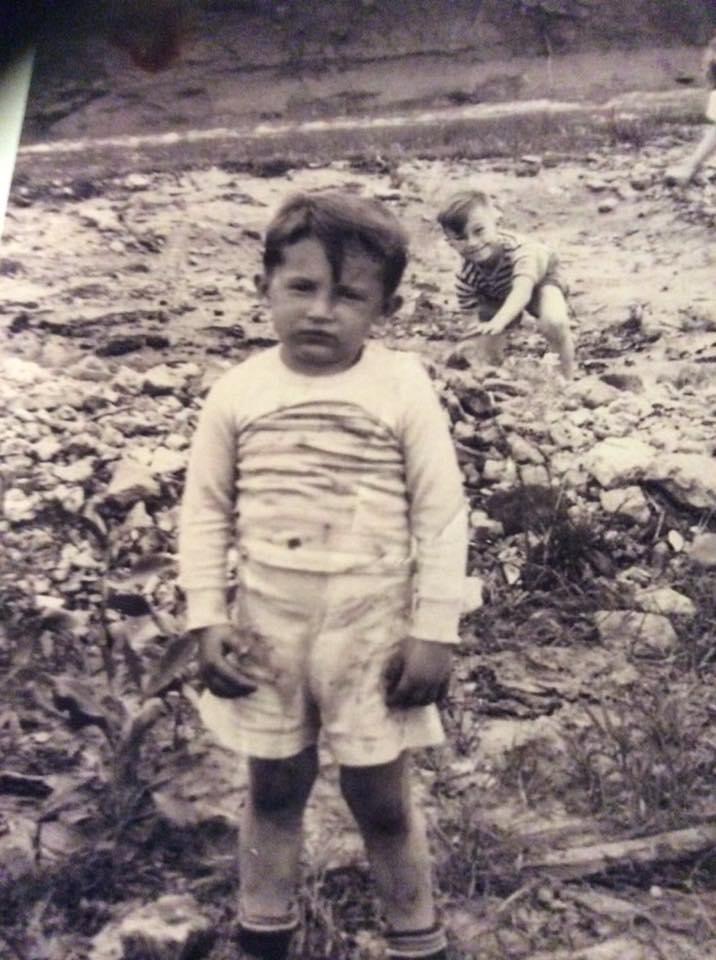
We all miss Wayne.  We all miss the man he was.  But I also miss the little boy he was…the one who always woke me up at 3AM to run down and see what Santa got us…who went fishing in a rain puddle with me.  Who let me wear his cowboy hat.  The one who lent me his favorite baseball mitt for the neighborhood game…okay, I may have taken that mitt without asking him. 

We miss him in all the ways he was to us: the brother, the husband, the father, the grandfather, the relative, the friend, the neighbor.  We mourn the bright light that has gone out in our lives. 

I paraphrase Anne Morrow Lindberg.  The pain we feel is universal, and understood by everyone.  And yet, it is very isolating, for each pain is different, and we each are alone in bearing it.  But my brother Wayne, your Wayne…never knew a time when he couldn’t lift himself up, out and on his way again with a smile on his face.  So can one with such a beautiful soul, ever be gone from us?

 We won’t let it.  We were better people around him, and we will remain so. 

As long as we can show any courage in facing adversity…display acts of kindness towards meanness…inspire a bit of laughter in tension…we will be honoring him, and he will be right there with us when we do.  We will keep him in our lives, and we will make him proud. 

Let us, through our pain of grief, remember that Wayne’s heart was larger than life because he made and lived it so…and because of that, it was large enough for a piece of it to stay behind, and comfort us, for all the rest of our lives.

 So let us then honor Wayne as he would want us to.  Let us grieve, but also let us try, between our tears…to find a way to smile…if even just a little. 

We will speak of what Wayne has given us, and our lives.  We all mattered to him.  We were all appreciated by him. We all knew we were special…and loved…by him.  Because that’s what Wayne would do in the end.…take care of the rest of us. This, family…this, friends…this, neighbors…is his everlasting legacy, and his profound gift to each of us. 

Peace, my beloved brother, Wayne.  Tell Mom and Dad I said hi.
New Year’s Eve 2001: A New Year in New York

It doesn’t matter who you are.  September 11, 2001, will haunt you for the rest of your life.

I wanted to pay my respects not just to Ground Zero’s victims, but to New York.  Like a funeral service, you don’t know what to say, but you want to say something.  I had to go, and so ion December 30, 2001, I did.

I flew into New Jersey and took the train to New York.   I was walking through the station to the street exit when I passed a long wall that was a memorial to New York and the victims.  Posters from grade schools kids;  photos (“Last seen at World Trade Center.  If you have seen…please notify…”);  a flower or two;  poems;  letters;  hundreds of messages.   I put my hand up and touched them, and felt the pain behind the pleas.

I checked into the hotel, set my bags down and headed for Ground Zero.   The cab took me to within a few blocks but got stopped in bumper-to-bumper traffic.  After getting directions from the driver, I got out and walked the rest of the way.

Groups of people were walking towards the site and I slid in alongside them, into their purposeful, quiet rhythm.  Police officers were next to the curb, trying to keep warm with a barrel fire.

I paused when I saw red, white and blue wreaths adorning an overpass.  I paused when I saw a fire department door with a sign thanking New York for its support.  I paused when I saw red white and blue ribbons tied on an iron fence.  I paused when I saw flags on balconies, in windows, on buildings, on police cars and fire trucks.  It’s one thing to see flags displayed here in the Midwest, it’s another thing to see them in New York.

You know when Ground Zero is around the next corner.  All of Manhattan is closed in with buildings, tall, taller and tallest, until then.  Suddenly, you look ahead and see a wide space of sky and you know.  The openness is eerie.

I walked alongside the barricades that were used in the first weeks to block off the street, but are now moved aside.  You can hear the cranes and trucks before you see them, and slight wasps of smoke from debris still smoldering.  There’s a slightly unpleasant odor in the air.  Police vehicles are parked everywhere.

The site was barricaded off, with police directing pedestrians and authorized vehicles.  A corner of the barricade was covered in photos, flowers, notes, wreaths, candles, and stuffed animals.  There was even a Christmas tree.  The people moved in, paused, took pictures or prayed or cried or all three, and moved away.  I heard someone behind me say, “The photos are hard to take.”  The faces of real people, real losses.

A tall building opposite where I was standing was blackened and charred.  The building to the left of me had it’s corner blown out.  The building to the right had boards where windows once were.

There was an opening in the barricade that allowed you to see a portion of the site.  Daylight was beginning to disappear and huge lights were shining on the wreckage.  I could see a crane, digging.  I turned right and moved to the next block.

A crew of rescue workers were going in.  Trucks were lined up to leave the site.  Tall, massive showers were built to wash down the vehicles before they exited.  A flatbed piled high with debris drove past me.  Twisted, mangled debris that I had no idea were cars until I saw the tires.  Another truck passed me.  They were taking the debris to the landfill site, where searchers would sift through it for human remains.  There were trucks stopped down the block and lined up to the right, waiting.  As a truck would leave the site, another, empty one would start up and take its place.  The trucks never stopped leaving, never stopped arriving.  Over and over, lines of trucks, 24 x 7.

It had turned dark and cold.  I started heading back, choosing to walk on the same street where thousands had run for their lives that day.  My psyche went backwards in time.  I felt the fear that had blasted down the streets; heard the noise that overpowered the senses.  With each step I wondered who had gone before me.  I prayed for them and their families.

I wanted to touch something, to feel something beneath my fingertips, anything to get the message to my brain that this was true, that an evil so great existed on my homeland long enough to cause a century of pain and tears. Why, why, innocent victims?  Why, why, the evil madness?

The next day I struck out again.  One of Mayor Giuliani’s last accomplishments was the opening of a public platform that morning at Ground Zero, and I wanted to go back.  But first I needed to see something else.  I walked from mid-town Manhattan to Central Park.

I’ve been to New York before, I know the cold reserve and rudeness for which New Yorkers are famous.  But that’s not the New York that survived September 11.  There are those tourists with cameras and accents or a language different from the native-born New Yorker, who kept to the themselves;  and, there were the teenagers or young adults who were totally absorbed in looking cool, as we all were then, who kept to themselves.  But loads of others — doormen, clerks, waitresses, walkers, police officers, shoppers — whose kindnesses were profoundly evident.  A smile here, a nod there;  a “pardon me,” an “it’s that way” with a smile and wishes for a happy new year.  It was like being home in the Midwest.

I found the Dakota and went past the doorway where John Lennon was shot down, which sickened me.

I crossed the street to Central Park to the mosaic memorial in Strawberry Fields, which made me feel sad.  I sat for a while and watched others pay their respects or take photos.  Before I left, I took off a glove and touched the mosaic.  I thought of the Beatle years and smiled.  Nothing could kill that.  I thought of September 11 and wondered what had survived for us.

I strolled through Central Park where dogs chased rubber balls or children twirled and laughed with the pigeons;  where lovers walked, absorbed in themselves and the bright light of the winter sun in the afternoon.

How could so much evil exist in a world of such beauty?

I walked back through Times Square where the New Year’s ball was being tested and hoisted, engraved with the names of the fallen rescuers.  Massive amounts of people were crowding into the area, working their way around the police vans and trucks, amidst the security personnel checking the area.  Then I went back to Ground Zero.

By the time I arrived, darkness was falling and the wind was making the air incredibly bitter.  The line for the public platform was stretched for two to three blocks.  The crowd was being informed that the average wait was 3½ hours.

I strolled on the street instead, which was partially barricaded from the traffic.  City Hall was nearby on the left and the St. Paul Chapel and Cemetery was on my right.

The church shouldn’t have survived, but it did.  It’s the city’s oldest church, dating back to the inaugural of George Washington as president.  Despite all odds, it was still there for the rescue workers when they placed the body of their fallen chaplain on its altar.  The iron fence in front was covered in flowers, wreaths, signs, candles.  One sign stood out, asking that no photographs be taken of the rescue workers, out of respect for their privacy:  they visit the church during their breaks.

I reached the public platform and stopped.  Only a small group of people are sent up at a time, but each group is allowed a few minutes before the next one is sent up.  People didn’t talk when they came down.

I looked up at the tall buildings still standing near the sight, knowing the towers had dwarfed them.  If they had fallen to the left or to the right, the destruction would have been immeasurable.

I headed back, scarf around my face and my gloved hands buried in my pockets.  Vendors were scattered throughout the area selling hats with FDNY, NYPD logos, peanuts, and pretzels.  So New York.

Why does evil live as one among us, a dark purple bruise of pain next to the yellow smiles and red hearts of beauty?  I don’t get September 11.  I want to get it.  To get something.   I was glad the church had made it through the attack.  It reminded me that we are in two worlds:  one that was created for us, one that we create for ourselves.  Life is a dance, partnering the two worlds.  I saw in New York, in all of us, a yearning to dance in rhythm with each other, to music greater than ourselves.

Why does evil exist?  Not why, but when.

When the dance step is not accepted, when the beat is not followed nor heard nor felt.  When what could or should be done is not.  When an act of kindness or the gesture of goodwill is skipped, and room is made for the uninvited guest to live as one among us, until it eventually destroys us.  Our hearts are like Ground Zero – there’s an empty space that haunts us.  If we fill it up with thoughts, actions, people, and events of good report, there is no room for unwanted guests.

The world is still good.  Good is still powerful.

I left New York the next day, but not before I signed my name to the memorial wall.

May peace be upon us all.

   — (c) St. John 2001