The Grace From a Child’s Eyes

I know kids, and I’m not enamored of them like some adults claim they are. Kids are loud, obnoxious and selfish, as the kid persona dictates they be. I don’t like that part, and you don’t have to either. However, respecting the human being inside the kid is an entirely different matter. That, you need to do and it’s easy — there is something innately beautiful behind a child’s eyes, and I’m a sucker for it every time. They always know it, too. It’s like they got some kind of strange radar zeroing in on me. It’s a good spooky.  Like the time at the mini-mall.

My brother and sister-in-law and I were there to browse and visit the boutiques. They wanted to go into a store that didn’t interest me, so I parked myself down on a bench in the walkway to wait for them. The bench sat parallel to the stores, so I could easily keep an eye on their whereabouts and hook up with them again when they were finished.

I had been feeling particularly frazzled and distracted the last few days. My job was a high-profile one in government, and the demands on my time had begun taking their toll. On call twenty-four hours a day, I had found myself with little time to sit and think, or to reflect upon my surroundings. Although I had been looking forward to my family’s visit and was enjoying our time together, my mind was still back at the office, whirling with tasks left undone from last week and tasks coming up that were critical to the office. I couldn’t wait to get back there and tend to my duties.

With my thoughts meandering into the best way to approach my latest project, I put my mind back onto the details of my work. But without warning, I suddenly turned my head swiftly to the right. Startled, all I saw down the walkway was a young couple with a baby in a stroller.

The man and woman were just another couple, and the kid was just another kid. Getting too many of them in the world, I would be quick to tell you. (Remember, I’m not fond of the kid part of kids.)  But I looked at the baby in the stroller as if I really had to see.

The kid was a boy, and looked about a year old. Sitting straight up and looking ahead, not wiggling in his seat, or fussing. Just calm and composed, as if he were floating, instead of being pushed. His face and his eyes locked into mine.

That’s what the human beings inside kids do.They crawl behind your eyeballs to see who you really are. After a few seconds, the kids are usually satisfied and look away. Most of the time, they smile before they do.  But not this little fella, no siree.

He stayed locked into my eyes, all the while getting pushed closer and closer to me. I think, “This is peculiar!” but I get into it and so I just sat still and let him look.

The stroller was now passing in front of me. The parents were unaware that he and I were looking deeply at each other, and so I smile, to tell him I see him. He does not return my smile. Even when he was pushed past me. While the stroller moved further down the pathway and away from the bench, the little boy bent over the side of the stroller, still drawing me into his eyes, still watching me. I expected him to be forced to turn away. But does he?  Nuh uh.  He just keeps his head towards me with eyes locked in, still staring while moving away.

Usually, I look away right about now. A person like myself has other things to do than stare back at a small child. There are great thoughts to think, errands to run, and all the other things busy adults take care of in their lives.

Not this time.

This time, there was something that was different. I didn’t want to look away. I would not have turned away for anything. It was this small boy himself. I wasn’t simply staring into a small child’s eyes. I was drawn in, like a bee to honey. Only the sensation wasn’t sticky…it was cool and soothing. Calming. I bent my head down to make it easier on the small boy to look into my eyes. There we were, two heads bowed down and turned towards each other, he and I, oblivious to everything and everybody else.

With this intense staring, the tense muscles in my neck and shoulders started to unclench and relax. Small sounds of laughter in the background somewhere tickled my brain and I felt good inside.Tidbits of animated, excited conversations crawled onto the edge of my consciousness and I was glad that good people still existed and in some places, all was right with the world.

The image of the stack of papers on my desk at work suddenly seemed to have shrunk to a manageable size, and faded out of my mind. Thoughts of a special dinner I could prepare for my family tonight to show how much I was enjoying their visit danced through my head.

Slowly, the small boy unlocked his gaze from me, lifted his head and and turned away. Once again, he was sitting straight up, gazing straight ahead, but this time, away from me.

I lifted my head up too then, quite aware that something extraordinary had just happened to me, but not being able to say what it was, exactly. But my body felt it fully.      A well-being shiver floated through me from the top of my mind to the tip of my toes, all in one flat second. I had never felt so beautiful or peaceful in my whole life, as I had at that moment.

My brother and sister-in-law came out of the store and I got up from the bench to join them. They were excited about showing me their purchases, and I was excited to let them. All thoughts of my job had been set aside. Instead, I was noticing the great smile my brother had, and the sparkle in my sister-in-law’s eyes. I knew what I was going to fix for dinner, and that I would take the time to tell them how much both of them meant to me.

I didn’t tell them about the boy. It seemed too special to share. When that small boy looked at my face and he didn’t want to leave my eyes, he gifted me with grace that touched my soul. His child’s innocence and complete trust in life had seemed to instinctively know that I needed to be redirected. That moment slid into my brain and hugged my frazzled thoughts and focused them towards things that truly matter in life: people, and time to spend with them.

As we left the store, I turned to look at the disappearing stroller and smiled.

Kids. They sure can surprise you, especially when you’re lookin’.


The Clearing

A  Lesson in Trust

He was her hero. She grew up worshipping him. That was the biggest mistake of her young life.

He forged through the underbrush, vines and trees ahead of her until they came to a small opening in the wild forest.  He stopped in mid-stride, causing her to stumble against him, almost falling. She recovered herself and stood upright behind him, breathing deeply, grateful for the rest. A small pool of water from a spring was to her left. She began to brush the bits of forest from her legs. That’s when she heard it. A different sound. Coming from his direction. Her head jerked up. But she was too late and he moved too fast.

Her face took the brunt of the assault, stinging and blinding her eyes, scratching her cheeks and slicing her lips. Her blood began to pour from all the open wounds. Then he pounded her back and neck, sending waves of searing pain throughout her body. She weakened as the assault kept coming. She was on her knees when he began to work on her arms, bludgeoning them into painful bruises until blessed numbness flooded over them. When her head and shoulders fell forward and onto the ground, he stopped. He was breathing heavily, excitedly.

Peering out of blood-filled eyes, she looked up at him. He was above her, staring at her with grinning satisfaction. He was no longer human, but a monster form. She began to control her breathing, lying still. He turned around.

She began to inch her way back up, lifting her shoulders slightly up from the ground. Plotting her return attack, she slipped her hand to her knife pack. But he was too quick. He jerked at a sound coming from a cluster of rocks at the edge of the clearing. He ran out of the tiny space and disappeared behind the rocks and deeper into the forest, leaving her alone and stranded.

She stopped her hand in mid-lift, frustrated and shocked. She gathered herself up painfully and stood, then went to the water to cleanse herself.

She washed for half an hour, soothing her wounds and caring for them. Her wounds were raw, but they would heal. Once a person she loved, he began to rot inside, and now – he was a beast. She would kill him, gladly and quickly. Not for assaulting her body, or for trying to end her life. But for trying to turn her spirit into his madness. She wanted to hurt him now, fast and hard. But she was also deeply afraid, and ashamed of her fear. He was all she had. The forest was bigger and more mysterious without him.

When she was through with her wounds, she gathered up her tools, leaving the food behind. It was poisonous, she knew that now. She would find safe and fresh sustenance.

She called upon her Spirit, the guide she had hid from him, which she knew still had strength she didn’t. “Spirit, I love and trust you will all my heart and will. I strive to bring you honor, joy and peace.  I am grateful for your presence, your inspiration, your total love and warmth.” She looked around, wondering if she could build an existence there. Are there beautiful animals of grace and dignity that would truly echo her love and trust? Or, because she once traveled with this insanity and did not see it, has she, too, gone beyond the realm of love and health?

The forest is YOUR realm, not his, my child. Get to know its beauty, its food, its creatures; live among them and respect them, so that a piece of them can be given you. You are transformed, rescued from all that you have carried. Hand over your bow, your arrows, your packages.  Stand before me transformed.  You are no longer here – the creatures of the forest have each given you themselves to carry inside of you, for strength.

It was not odd for her to hear direction. It was how she had survived growing up. It was time to move on. She took three steps and saw the odd light of a rock.

It wasn’t a rock. It was a tiny, tiny piece of crystal. It glinted and shone, so like her spirit within. There was no mistaking where it came from:  it came from the huge mountain itself that dwarfed the forest. She picked up the piece of crystal and turned it over in her hand. Light sprang out from multiple facets. It was more glorious than anything she had ever had. He would stay any from her because he was a coward, and could not face her now that she knew what he really was. She would be safe from him because he would no longer matter. She slipped it into her pocket.

For days and weeks, she glided through the forest. In each creature, she saw the wonderful eyes of her Spirit. Then on the day the sun was shining the brightest she had ever seen, she came across a new clearing. The air was sweet and caressing. The trees swayed in the breeze. The flowers bloomed and became fragrant. The water flowed in sparkling clarity. There was peace and love in that space.

She sensed he was coming nearer. The clearing, whether he came now or later, was safe, and the plants and animals knew it.

She settled into the clearing, gathering her power. She need not look for him any more and waste her strength. He would come back searching for her, of that she was certain. He would track her, stupidly.  He would become his human form again, hiding the madness and he would beg. He needed to lie in the places he had before, in the light.  He would find her and she would strike him. First in the face, then the head, then the back. She would do that with the tool of power – his own madness. Then, when he survived and crawled away, he’d drag his adversarial madness with him.

Like she did every day when she returned to the clearing, she sat very still, holding the crystal in her hand. The light reflected out in all directions.  “I am everywhere,” her Spirit was telling her.  “Embrace me and take me with you in your heart. We are the power, we are the strength, we are the peace.”

It was time to move to the edge of the clearing.  She slipped the crystal into her pocket and went to the fire pit she had built, spreading out the embers so the fire would die out.  She would not leave that for him.

She was on the edge of the clearing, hidden. She looked around.  She had seen old tracks and now heard him before she saw him. Seconds later, she spotted him on the other side of the clearing. He was no longer alone. Stealthily, she made her way to him and his small band of followers.

He had not heard her approach. She was so livid at seeing him that she wanted to rush up and crush his bones and smash his teeth, just to hear him whimper and whine. Yet anger would not dictate her actions. Anger was not a strategy. It was only an energy that took her to him. She watched him.

He crawled easily into the clearing, but suddenly saw it is a ruse. He is posed to run. He had painted a mark on his face that hid the cruelty of his lips; he was wearing a mask over his eyes to hide the madness, the hyena eyes.

She saw it all.

She would never have come into the open. Yet she saw why he had – his pack of smaller hyenas were right  behind him, barely containing their excitement. hey were getting animated by his actions, and the sight repulsed her. He was doing it for them; a pathetic show.

He did not know she was there.

Watching the madman put a bit of dance into his step, and his followers howl with religious fervor, made her grimace. Such fools!

He lay a pound of food upon the ground, then stood up, danced and whooped. His pack went wild and mimicked him.

She saw the deception in the offering of food. Then saw the pieces inside that sparkled in the morning sun. Glass.

She could easily kill him. Her Spirit knew that and would not stop her. She could scatter the pack, all the while inflicting wounds, trying to rid herself of all her hatred and anger through viciousness. Then he would know she was there, that she had gotten her power. She knew her Spirit would remain calm, serene, loving. Did her Spirit trust her so with one who doesn’t deserve kindness?  Her Spirit would not look at her differently, she knew that.  Its look would always be welcoming, always full of love. So why didn’t she act out of anger and hatred, knowing nothing would cause those eyes to stop loving her?

Because the hatred would be turned back onto her, and she’d run from those eyes because she would not want to see herself mirrored in them. She would be like him.

She stood up then and walked into the clearing and stopped, in full view of all of them. He and the pack were so self-absorbed, they did not even notice her at first, so thick was the veil of their self-deceptions.

“I will take it.” Her Spirit said simply. “You have carried it enough. Now it is my turn.”   A hand slowly appeared in the air between her and the pack. She looked up into her Spirit’s eyes and then glanced back at the mad man. He was still dancing. He was still mad, mean and petty. The pack was vicious and cruel.

She placed the tiny piece of crystal in the outstretched hand of love. A fist closed upon it.  She sighed deeply, feeling all the eyes of love upon her. She knew then that her Spirit had chosen this place for her, in the forest of so many eyes of love, to weaken the man’s assault, to slow down the man’s walk. If ever he returned, it would be indifferent to her.  This was her clearing now and he would have no power here.

The hand disappeared and she was staring at him again. He was limping now, but she had not touched him. The pack sensed something and were beginning to scatter in panic.  Already things were changing.  She watched as the madman and the pack whimpered away, and until the peace settled once again upon the clearing.

She looked down at her empty hand.  In giving up the piece of crystal, she had gotten the whole mountain.


Home At Last

I was born and raised in a small town nestled in a little area off a state highway, population 300.  There wasn’t much to it but what was there was pretty:  a nearly oval park smack dab in the center, and when the sewer running through it was removed, was downright enjoyable to walk through. The hills were peppered with homes of all shapes and sizes and trees of all kinds – clusters of trees in beautiful summer greens or bursts of autumn oranges, reds and yellows. 

The whole town was my playground. My two best friends, Dianne and Elaine, lived at the end of my street. We were always together, running around the neighborhood or going to the park, and always wondering what it would be like to be all grown up. That was the good part. The bad part was, I couldn’t go anywhere without someone knowing me, so I couldn’t get away with anything.  By the time I got home, Mom had heard all about any misdeed from at least three different people and she was standing on the porch with a flyswatter, ready to beat the evil spirit out of me that disgraced her, her parents, their parents, and their parents’ parents.

My teen years were suffocated by everybody knowing everybody else’s business in town and commenting on it, so I escaped in early adulthood by marrying a man from the nearby city of 60,000.  I rarely went back home, and only then for obligatory family events.

Eventually, my parents moved away to a larger town of 3,000, and I was spared the discomfort of returning to my childhood town. “There’s nothing there for me,” I always remarked when asked if I kept in touch with anybody from my past. My childhood’s boredom was nothing I wanted to relive, nor the choking sensation of growing up. I didn’t want to risk the chance of getting swallowed up in small town living again. 

Then a decade or two later in late summer, I was on the highway headed somewhere else when I neared the exit for my small town.  I was surprised by an irresistible urge to turn off the road and revisit my childhood. I’d driven past that exit many, many times, never feeling such a desire. I suddenly decided it couldn’t hurt to see what had happened to the town.  “Besides,” I reasoned, “I have time, and it’s a good day for a little drive.”  

The day was a Goldilocks one:  not too hot or too cold, a “just right” temperature with a cheerful sun.  I turned and drove the three miles into town, rounding past the house we moved into when I was fifteen, remembering the panoramic view of the town from there. In sweatshirt weather, when the air would get so crisp you could almost reach out and snap it in two, I’d sit outside to think.  Dusk would settle and the sky would get that grayish color it always gets around 5:30pm on a late fall afternoon. Slim spirals of smoke would curl from chimneys and perfume the town with the scent of burning wood. I wouldn’t notice it getting late until the ground turned so cold it started freezing my bottom. Only then would I march inside to be greeted by the blast of heat from the furnace and the smell of dinner on the stove. Only, we called it supper then. 

I curved into town and around the park, heading straight down the road past Junior’s Tavern, to the gravel area at the end. A train once ran through the nearby pasture, and when I was little I had peeked into the abandoned depot sitting among the weeds. It had smelled old, and I wasn’t interested in what it used to be. I was going back now, though, because of one night when I was seventeen and my impression of the abandoned building changed. I had ventured to the dead end for solitude, to think. The moon was full and cast a deep shadow across the gravel, silhouetting the stillness of the night. I stared at the old depot for a long time, when passengers began to emerge from a fog into full view, getting off and on the train. The steam hissed from the side of the train, and iron clanked somewhere. I could smell metal from the tracks. Then it all faded away, and I was back to myself, staring at an empty building. I was hooked on the place after that. 

I stopped the car. I’d heard that someone who grew up in town refurbished the building, and it was now a local attraction and open for tours on holidays. The depot was completely transformed into its original dignity, so like what I had witnessed that night many years before. I wondered, as I got back in the car and drove away, if, as a teen, the remodeler had ever been there at night during a full moon.

I drove back to the center of town and cruised slowly around the park. Our Fourth of July celebrations always took place there. For reasons beyond my comprehension, thousands from nearby communities would join us for our patriotic eating and drinking, bingo-playing, carnival gaming, and then the piece de’ resistance; a rip-roaring dance under the pavilion. Wonderful memories, but it was the winters I liked the most. The same pavilion was iced over as a rink for skating, and my friend and I were usually there until it got dark and the streetlights went on, a signal to return home. Our noses would freeze, our toes would tingle, and our hands felt so numb you thought you’d left them somewhere back on the ice when you fell that last time.

The small, brick bandstand always held the manger scene at Christmas, and since the baby wasn’t placed on the straw until Christmas Eve, you could sit on the bales and gossip while you took off your skates and rubbed your toes. The snow blanketed the trees and ground, softening our steps and our voices as we walked out of the park. 

I turned left and started up the steep hill.

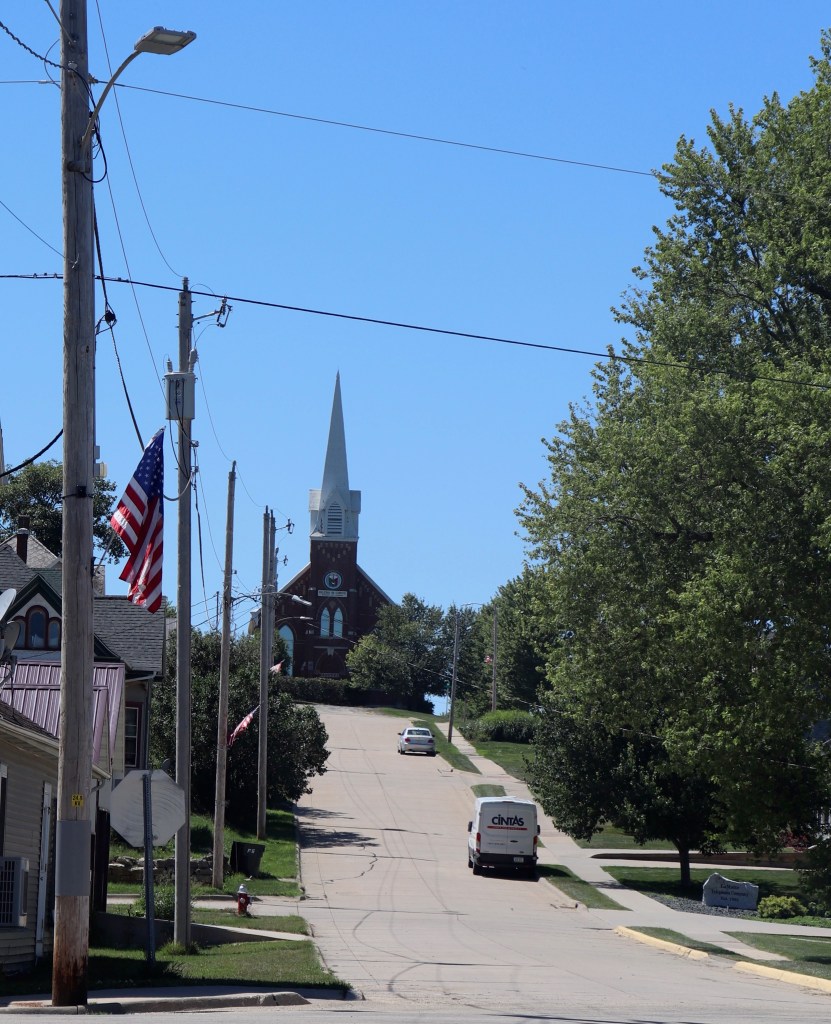
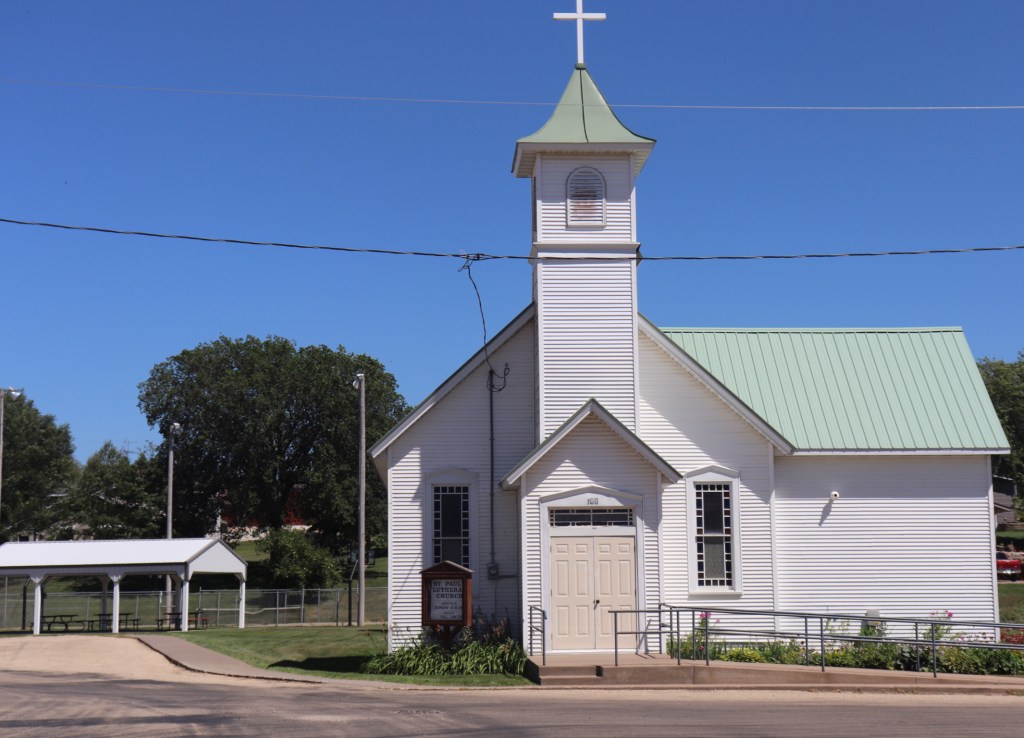
There are two churches in the town. The one straight ahead, sitting majestically atop the hill, and the smaller one in my rearview mirror, on the other side of the park. It was a town of The Catholics and The Non-Catholics. It was The Catholics who built upon the hill.  No modest, unassuming structure for them, thank you kindly. The imposing brick structure had been one of five:  the church, the rectory, the convent, the grade school, and the high school. The brick convent, grade school and high school were torn down years after I moved away. 

The Non-Catholics, on the other hand, were satisfied with a little white, dignified wooden structure that was heated by a pot-bellied stove. Growing up, my brothers and I were never allowed to fraternize with “those other folks”.  I only know about the pot-bellied stove because I peeked through a window on my brother’s dare. To this day, I still don’t know who those Non-Catholics were, where they lived or went to school.

This hill was always the best for sleigh riding. The bottom of the hill would always be closed off after a good snow so we could get our sleds out and ride safely. But I don’t think anyone really needed a sign. The adults just knew to keep their cars away from the church hill after a snowfall or they would run over a sledder. It was an okay ride if your sled stopped at Elaine’s grandmother’s house halfway down, a good ride if it stopped at Herrig’s garage as the street leveled, but a great ride if you coasted another half block to Manderscheid’s Tavern. 

I was two-thirds up the hill when I turned onto my old street and stopped across from my childhood home. Anyone who ever grew up in a small town knows the stir a stranger can cause. I surely did, and there is nothing worse than an out-of-town car with somebody you don’t know sitting in it. So I parked the car and quickly shut off the engine. I didn’t want to make any noise and disturb anyone. 

I sat there peering at the house, suddenly realizing that it was once a large structure chopped into two components. Funny – I never noticed that as a kid. 

Our side had two rooms down, three rooms up. We never had hot running water so we always had to heat water in a big kettle on the stove. The bathroom was added when I was about four years old, but it didn’t have a bathtub, so on Saturdays Mom grabbed a huge vat, set it on the stove and filled it with water.  After the water was heated, she rolled the wash tub into the kitchen, locked the door against unexpected visitors, and called each of us one by one to our bath.  After we outgrew the wash tub, Mom took us to her mother’s to use her bathtub.  She caught up on the family gossip while waiting for all of us to get clean. 

I looked at the second floor where my old bedroom was. It was the width of a twin bed, with just enough space for one small dresser. My bedroom claimed the only closet in the house. That was okay, though. We had very few clothes to wear so we needed little storage. I wondered how long the magazine photo of Paul McCartney had stayed on the wall.

I noticed the flowerbed in the front yard was gone. That was too bad. I loved the bright orange tiger lilies. Then I began to realize how quiet everything was. No traffic, no machinery, no blasting stereos. Just the birds and leaves rustling in the breeze…kids playing… and grownups talking in their yards. “I miss this quiet,” I thought. 

I was staying dangerously late and pretty soon the word would spread through town that a stranger was hanging around. I didn’t want to run into anybody from my previous life then be forced to explain to them what I was doing there, and why. I reached out for the key in the ignition.

Without warning a tribe of ruffians came racing from the back yard and around the corner of my old house, yelling, “Hurry up!” and laughing. I looked back at the yard. It wasn’t a tribe at all, only three little girls, about eight or nine years old, and certainly not ruffians.   blonde, a brunette and a redhead.  Unusual combination any time, but particularly for a small town. It was the brunette, though, who caught my eye, and who I watched most intently. She was the grubbiest – hair askew, knees scuffed up, tee shirt unwashed for several days from the looks of it. I found myself liking her right away. I could tell the three girls were great friends, too. Lots of deep conversations, frowns, nods, laughs, and songs. The brunette had vibrant energy, a light laugh, and what appeared to be  unbounded joy. She radiated strength and curiosity. I sat there enjoying the scene until I heard women calling the girls home for dinner. The blonde and redhead raced off. The brunette opened the door and walked into my house. 

I was just about to restart the car when my eyes whipped back to a sudden sound from the house.The door had slammed and the little brunette walked quickly to the corner of porch that separated the house in two. She had a blanket in her hand that she wrapped around her shoulders, then put her back against the corner, and skidded down the wall. Her little body plunked onto the porch floor. She tightened the blanket around her then drew her knees up to her chest, wrapped her arms around them and put her head down. She seemed to be crying.

Then her head moved up and she looked straight at me, as if hearing something.

We stared at each other for what seemed a very long time. Then she disappeared. And I suddenly knew the reason I had turned off the highway. 

I guess it was easy to let my thoughts wander aimlessly as I sat in my car, staring at the house. It was all so quiet and safe. There had been no actual children in the yard.  In my mind, visions of forgotten play times came as clearly into my sight as if it were happening for the first time, with my best friends. Redheaded Dianne and blonde Elaine had materialized right along with me. As I watched myself play, I was shocked to discover how “normal” I had been. How easily I had liked that little girl. I hadn’t felt either way when I was living it. My mom, angry at me one day when I was about six years old, sneered at me that I was bad, and no one would ever like me if they ever got to know me. My dad would mock me, humiliating what I would say to him as a joke in front of others.

Suddenly, I remembered something important that I had blocked out all these years.

I was nine years old. After spending the afternoon playing with my friends, I walked into the house and stepped right into my parents’ fight.The insults were beginning to be hurled back and forth, and I knew they would eventually target me again if I stayed. I grabbed my blanket and escaped back outside to my special corner of the porch. I put my back against the wall and slid down onto my behind. I pulled up my knees and put the blanket over them, bringing it up under my chin. I closed my eyes.  I would have stayed like that, but I heard the sound of tires on the gravel street in front of my house, and I knew a car was coming. Most people walked around town instead of driving. Who could that be? Curiously, I looked up. But no car was there. And I hear, “You are going to remember this one day.” With a child’s innocent trust, I accepted it and put my head back onto my knees.

It was this car she heard. Now, today, decades later, I was learning who that little girl really was. I was simply a blameless little girl growing up abandoned by the people around her. And I liked her. I would never abandon her, ever again.

Peace flooded through me in one huge wave, settling into stillness. I stared at the empty porch corner for a few more moments before I started the ignition. Before I turned the key I paused, and glanced at the passenger seat. I knew the ghost of the little girl I had been was sitting there. She looked at me, then smiled and turned to stare straight ahead at where we were going together. I smiled to myself and started the engine.

I looked back at my childhood house one last time. I drove slowly away, saying an affectionate good-bye to it, and the town. 

Many years have passed since that day in late summer when I turned and drove into my hometown. I’ve never had the urge to go back, and I don’t think much about it any more. 

But once in a while, when the air is so crisp you can almost reach out and snap it in two, I grab a sweatshirt and go outside. I watch the dusk begin to settle and the sky turn that grayish color it always gets around 5:30pm on a late fall afternoon.  I think of my hometown with the buildings clustered around a small park, the few hills full of homes, and trees bursting in beautiful greens or autumn oranges, reds and yellows, and the pretty depot at the end of the street past Junior’s Tavern. I smell wood burning somewhere, and look for slim spirals of smoke floating up from chimneys. I don’t notice how late it is until the ground gets so cold it freezes my bottom. Then, and only then, do I march inside to be comforted by the blast of heat from my furnace and the smell of dinner on the stove, and I smile. When I do, my happy little girl smiles right back at me.

I’m finally home…home at last.

On a corner on my sidewalk, my soul whispered.


The November morning is damp and gray. Soaked leaves coat the sidewalk and cling to the street. The houses seem still. No one is about. It is just barely past a gray dawn, and I am walking. Yard light sensors go on as I walk by. I am being rained on. If I am going to be serious about being fit, I better be serious and just do it. I am furious.

My pace is brisk. I see 2 pairs of ducks floating on the retention pond as I pass by. Early birds chatter in the trees. A train whistles in the distance. I am furious.

White supremacy has politically raped we women. Again. And this is both from white men, and tragically, white women. The nightmare will soon commence. I am furious.

As I turn a corner on the sidewalk, my soul whispers to me. “We got this. We are working on correcting this.” Then you damn well better speed it up, I whisper back. I am furious.

My soul is not silenced. It is gentle. “In the most horrific of Bad, there is still good. In the Good, there is no bad. Good is more powerful than Bad. Find the Good. Embrace it. Harvest it. 20 seconds is all it takes.” I walk. My rain suit crinkles in the quiet with each step. I am focused.

I hear the train whistle and for 20 seconds, I hear and feel the serenity in it. The birds chatter and for 20 seconds, I hear the songs of purpose. I pass the 2 pairs of ducks on the pond, and for 20 seconds, I admire their calm, their grace. I am thoughtful. We women and our evolved men fought for the good and dignity of humanity, for truth and integrity, and came together.

My good friends and good women and evolved men everywhere
…we are not done. Self care. Heal. Your soul will whisper to you. Embrace each Good and harvest it for 20 seconds. When we embrace even the smallest speck of Good, it will seek out other Good and connect deeper. My soul whispers to me again. “You can create your own Good, too.”

You are good people. In your intense pain you are still kind, still focused, still compassionate. Be strong. Do not give the rapists an inch. But don’t hesitate to plant your Good on fertile ground. It will be embraced. It will grow the way to truth, integrity, and the power to correct this nightmare.

I walked up my street on my way to my home, my rain suit dripping from the warm drizzle. A dog barked. A woman walked to her car. People were waking up.

We will make sure they all do. And so it beings…with us. With Good. We WILL bring our country through this wall and out the other side, intact. How? I don’t know yet. I’m still in self care mode. But I do know this: our souls will whisper to us the how, the when, the where. We are not alone.

Go in peace and Good, my friends. ‘Til we meet again.

A Tribute to my Brother on the First Anniversary of his Death

He was a proud veteran; a devoted husband; a loving family patriarch; a kind neighbor, a loyal friend. And to everyone, in any role, on every occasion, Wayne Konrardy was a good man. 

When we lost him unexpectedly and tragically on January 10, 2023, we, from all generations and diverse families, from all walks of life, states and countries, gathered together to honor him, to pay tribute to him, to show our collective love for him.  The more than 500 people who gathered that afternoon…who waited an hour and a half to pay their respects and didn’t care it took that long…each of them had a story of him to tell.  I listened to everyone. Every story was “so Wayne”. But my story is different.  I grew up with Wayne.  He was my brother, my protector, my birth family.

When asked to tell what my brother Wayne was like, I always described him as somebody who, within 5 minutes of talking to him, you would already be feeling like you’d known him for years.  He made lifelong friends in instants. As his wife, Mary, can attest to, even new geography couldn’t stop him from finding people he liked, and making new friends. Some of you reading this, are one of those who met him on your vacation, and became lifelong friends. Only, lifelong was supposed to be longer.

In his long career of selling cars, he believed that integrity mattered, and relationships with people were the priority.  That’s probably why so many of who bought cars from Wayne, still reached out to him when he retired, for help purchasing a new one.  You could trust him. 

Wayne didn’t always like the new people he met.  But his opinion came second to his kindness, and respect for each person’s right to be treated with dignity.  Sometimes, he wasn’t too keen with people who weren’t even born yet.  He liked to tell people that when our mom and dad left for the hospital to have me, he was full of excited anticipation.  For they had told him that they’d return home with a wonderful surprise, just for him.  He was convinced he was finally getting his biggest wish.  When Mom walked in a week later with me and proudly introduced a baby sister to him, he exclaimed in horror, “I thought you were getting me a pony!” and walked away, crying.  Our parents dismissed it, knowing that once he got to know me, he’d love me.  But it would take a while.  He slipped me in his wagon one day when mom was occupied with doing the laundry, and quickly took me to our elderly neighbors who had no babies of their own, and tried to sell me.  Once or twice in the next few years, especially when I became a pest following him around, I would hear him mutter, “shoulda been a pony.” 

Wayne’s gift of salesmanship may have failed with the elderly neighbors, but it worked with me. All I knew of my big brother, was that he wouldn’t let anyone else speak ill of me, hurt me, or ignore me. I loved my big brother.

As we grew up and began to earn money with odd jobs, it was obvious that I was more “careful” with my coins than Wayne was with his.  Which translated, meant that I was tight and Wayne was generous.  Even as a young boy, any money he had he would share with his friends. For  a day or so after any pay day, Wayne was the grand host. But before the week was out, he was putting on a smile and trying to talk me into buying something of his so he would have the money to treat himself and his friends at the corner store.  I held on to my money.  Until one day he got his hands on a small teddy bear. He offered the cute furry thing to me for the bargain price of a soda and chips. I caved and paid him. 

When Wayne became short of money again, he recalled he had had a winner with the teddy bear, except there was a slight problem – he only had the one he had sold me.  He solved the problem by sneaking into my room when I was playing outside, grabbing it, and presenting it to me as a new one, for the same great deal of a soda and chips. I bought “that one”, too. 

It became a running joke with Wayne that he kept selling me the same teddy bear over and over for about 3 years, and I never knew it.  The truth that I can now share with you is this: I always knew it was the same teddy bear.  I kept “buying” it because it was the only way I could give Wayne my money without his knowing it was only because I liked him.  I had my pride, ya know.

 Wayne was graceful and sure on his feet as he grew up.  He loved to dance, to roller skate – to move.  He was in sports and a skilled baseball pitcher and batter in high school.

He was not an arrogant man, but as he aged, he found no problem mentioning his ping pong skills.  It was true that he was an undeclared champ…taking his honed skills on the road, on his travels, whenever a resort provided a ping pong table.  He told me the story once of being at a beach on vacation and watching a couple playing ping pong.  He said he casually sauntered over and inquired into the game, and struck up a conversation.  Sure enough, he was asked if he wanted to join them and was offered a paddle.  He coyly hesitated a bit, then smiled at them and to their shock, promptly kicked their butts for the next 3 games.  He laughed for months afterwards, telling the story, knowing he “still had it.” 

My brother loved music.  Back in the day, that meant the kitchen radio at night and station KAAY out of Little Rock Arkansas.  It would sometimes take Wayne a full five minutes to get it tuned in, but then we’d listen for as long as Mom would let us stay up.  Together, he and I became part of an historic event one bright, summer Saturday, because of music. 

I was in the living room when Wayne, in the kitchen, came rushing to me, grabbing my arm, saying excitedly as he pulled me into the kitchen, “You’ve got to listen to this group!”  I stood next to him, ears cocked to the radio.  Out blasted the best song I had ever heard.  We stood there together, rapt, tapping our feet and hands, mesmerized by the rhythm, the beat…it was unlike anything we had ever heard before, and we were loving it.  When the song stopped I asked Wayne who the heck was singing that great song!?!  He said he heard the band was odd looking with really long hair and from England.  Moptops, he said they were. 

He promised he would go to K-Mart that week to see if the record was in stock.  It was, and that’s how we became one of the millions who owned the single, “I want to hold your hand.”  I still brag that Wayne and I both knew from the very beginning, that the Beatles were the greatest musicians of all time.

My brother was a born charmer.  One of the most charismatic people you’d ever meet.  When he smiled at you…talked to you…he looked you in the eye and you felt like you were the only person in the room.  He became the best friend you ever had.  He was an easy person to talk to, confide in, and his laugh was contagious.  I had more girl friends than anybody else in school, because every girl in the building had a crush on him and wanted to follow me home, just to gaze upon him for a minute or two.

He stayed the kind of guy you always turned to if you needed advice, or help, or just wanted to enjoy the day talking and laughing.  He made you a better person just being around him.  He showed you the better side of yourself…and with it, the world seemed a gentler place.

Above all else in his life, the one person who mattered the most to Wayne, was his wife Mary.  The love between Wayne and Mary is the down-to-earth, uplifted, special, and profound love that we all hoped was in the world, but wasn’t sure it was, until them. 

With Mary, what gave him the greatest joys and pride in his life was his family.  He devoted his time to their two sons, John and Jim, their daughter-in-law, “the Kid” Dawn; their grandchildren and the loves in their lives, and the great grandchildren. But his love didn’t stop there. He extended his pride and love to all his family beyond his core one, to aunts, siblings, nieces, nephews, godchildren, cousins, and on and on.  

Cancer brings us to our knees.  It diminishes the quality of life of those we love, and takes them from us far earlier than life should.  Yes, cancer brings us to our knees, and it did Wayne. 

But he didn’t stay there. 

The word, “hero” is defined as a person who is admired or idealized for courage, outstanding achievements, or noble qualities.  There are war heroes, and heroes who save people from accidents or possible death.  But if ever they create a category for “hero of the spirit”, it would be my brother Wayne. 

He straightened up his body from the blows each time, and stared that evil cancer  in the face, full on.  He would not allow it to define his soul.  He faced the harsh treatments with gratitude that there were options.  He refused to be bitter and kept his kindness to all living creatures in spite of the injustice of his illness…he expanded his love for his beautiful wife, his family, friends, neighbors…to all of us.

Like all who knew him, I came to admire him even more during his illness, for his courage and tenacity, and how, instead of being bitter…whining…complaining…he smiled.  He joked.  He told his stories.  He was compassionate and loving.  He was a gentle man, strong in his belief that life was to be lived with gratitude, every minute, every day. 

We all miss Wayne.  We all miss the man he was.  But I also miss the little boy he was…the one who always woke me up at 3AM to run down and see what Santa got us…who went fishing in a rain puddle with me.  Who let me wear his cowboy hat.  The one who lent me his favorite baseball mitt for the neighborhood game…okay, I may have taken that mitt without asking him. 

We miss him in all the ways he was to us: the brother, the husband, the father, the grandfather, the relative, the friend, the neighbor.  We mourn the bright light that has gone out in our lives. 

I paraphrase Anne Morrow Lindberg.  The pain we feel is universal, and understood by everyone.  And yet, it is very isolating, for each pain is different, and we each are alone in bearing it.  But my brother Wayne, your Wayne…never knew a time when he couldn’t lift himself up, out and on his way again with a smile on his face.  So can one with such a beautiful soul, ever be gone from us?

 We won’t let it.  We were better people around him, and we will remain so. 

As long as we can show any courage in facing adversity…display acts of kindness towards meanness…inspire a bit of laughter in tension…we will be honoring him, and he will be right there with us when we do.  We will keep him in our lives, and we will make him proud. 

Let us, through our pain of grief, remember that Wayne’s heart was larger than life because he made and lived it so…and because of that, it was large enough for a piece of it to stay behind, and comfort us, for all the rest of our lives.

 So let us then honor Wayne as he would want us to.  Let us grieve, but also let us try, between our tears…to find a way to smile…if even just a little. 

We will speak of what Wayne has given us, and our lives.  We all mattered to him.  We were all appreciated by him. We all knew we were special…and loved…by him.  Because that’s what Wayne would do in the end.…take care of the rest of us. This, family…this, friends…this, neighbors…is his everlasting legacy, and his profound gift to each of us. 

Peace, my beloved brother, Wayne.  Tell Mom and Dad I said hi.

A Time Long Gone: Christmas at the General Store

images

(Published in the Bellevue, Iowa, Herald Leader on December 26, 2007)

The wind had stopped howling.  Snow was piled high outside.  Mom gathered my pink snow pants and coat from the peg rack, found where I had dropped my mittens, and grabbed my boots from where I had tossed them the day before.  She gave orders as she marched to me, laden with all the bundling a five-year old needed to brave the winter in a two-block walk to the store.

“Now, Karen, see that you go straight to the store and back.  Ask Teresa to help you.  Get the mail while you’re there, just ask them for it, they’ll give it to you because they know who you are.  Do you know what you’re going to buy?”  She asked me, inserting my legs into the snow pants.

“Yep!”  I proudly stated.  “Something pretty!”

She turned to me with that gentle smile that lit up her pretty brown eyes, pulled up my snow pants and buttoned the waist.  She grabbed the boots and zipped them up, making sure my snow pants were deep inside each one.  She reached for the coat she had set on the floor, and started slipping my arm into the sleeve, “Okay.  Don’t take too long, I don’t want to send your brother for you.”

Well, neither did I.  I was five years old and having an eight-year-old brother come to fetch me was an affront to my dignity.  Besides, he’d be mad and would probably punch my arm.

Mom finished buttoning my coat.  She put the hood up, and then wrapped a scarf tight around my cheeks.  My eyes bulged.  I’d slip it back down when she wasn’t looking.

One last look from her and she was satisfied I was prepared to go out into the world.  She grabbed the eight singles out of her apron pocket, folded them carefully, and put them in front of me to see.  “This is your Christmas money now, Karen.  Don’t lose it because you won’t get any more.”

“I know,” I said, full of responsibility to be toting such wealth.

She opened the edge of my right mitten and slipped the folded currency into the palm of my hand.  “There!  You’re all set.  Don’t forget the mail.”

“I won’t!  Bye, mommy,” I replied as I opened the kitchen door and walked outside onto the porch.  I jumped off onto the sidewalk.  I heard Mom shut the door behind me after she told me one more time to be careful and come straight home afterwards

The sidewalk was shoveled, so that was no good.

I made straight for the deep snow in my neighbor’s yard and trekked deep foot holes into the new snow, pulling the scarf down and away from my mouth so I could watch my breath.  I turned the corner and headed downhill to Nemmers’ general store, keeping in the ditches and the snow.  I was feeling very grown up.  You had to cross the main street to reach the general store, and little kids weren’t allowed to do that.

When I reached La Motte’s main street, I stopped, looked for cars first, and then crossed the street — all by myself.

I tromped up the cement steps in front of the general store, grabbed the door handle and swung the door wide open.  A warm blast of air greeted my cold nose and the door slammed shut behind me.

The store was long and narrow.   To my left was a wooden counter with drawers that had glass panels in the front.  To my right was another long, wooden counter with metal boxes with combination locks.  That was La Motte’s post office.  Straight back, on the left before you got to the meat counter, was a chair and a large floor cooler full of ice cream.  Kate, a plump, gray-haired woman, was a permanent fixture.  She always sat in the same chair, knitting or crocheting. Opposite Kate was what I was ultimately after:  a glass-shelving unit full of wonderful, pretty items, just waiting to be purchased for Christmas.

I looked around for Teresa.  She walked out of the family’s private apartment through a door in the wall behind the glass shelving.  Tall, slim and also gray-haired, she was my favorite.  I walked up to her.

“Hi, Karen.  How are your mom and dad?” she asked.

“Okay,” I answered.  I tore off my mittens, proudly showed her my wad of money and announced, “I’m here to do my Christmas shopping!”  I was very excited.  I told Teresa that it was my first time all by myself, and I could pick out anything I wanted.

Teresa’s eyebrows rose at my words and she said, “O-o-o-h.”

I knew she was impressed.

She went behind the counter and asked, “Who do you need to buy for?”

I rattled off the names of seven relatives.

“Do you know what they would want?” she asked.

Teresa listened while I told her what everybody in my family liked to do.  For twenty minutes, she showed me bright combs, decorated coffee cups, shiny nail clippers, colored vases, embroidered hankies, brightly colored pens…a veritable treasure chest of wonders!   Teresa greeted people as they came and went from the store as I made my careful and well thought out choices, but she never once left my side.

Soon, the number of people left to buy for was one:  Mom. My eyes rolled over the items on the shelves, when I spotted a beautiful metal trivet. I pointed to the trivet and Teresa reached in for it, grabbed it, and gently put it into my hands.

The face was a painted ceramic tile of beautiful purple flowers with dark green leaves.

The scalloped edging folded over as legs.  I wiggled the edging back and forth.  I was completely charmed.  I looked up at Teresa with my eyes shining.  “I like it!”  I said happily, thrilled at the thought of happiness the trivet would bring my mother.

“Karen…” Teresa started to say.  She had just finished tallying the items I had chosen and a small frown creased her brow.

I stretched out my hand for her to count the money again and asked, worriedly, “Do I have enough?”   I could not imagine a Christmas without the wonderful look on my mother’s face when she unwrapped her trivet.  I waited expectantly.

Teresa didn’t pick up the money to recount it.  Instead, she continued to look at me.   I stretched my hand out further to her, since she couldn’t seem to reach it.

Her face suddenly softened.  She reached her hand out, closed my fingers over the wad of money, patted my fist, and said with surprise, “Well, what do you know?  It costs just what you have left!”

My face lit up with relief as I heard those magic words.   Teresa added the trivet to my purchases.  I followed her to the cash register at the candy counter, completely bursting with pride at having successfully completed my first solo shopping expedition.

As she began to ring up all the items from my Christmas shopping, I scanned the candies behind the glass in front of the drawers.  I pointed to some colored candy balls and asked, “How much are those?”

Teresa leaned over the counter to see where I was pointing and said, “Two pennies apiece.”

“I’m getting some if I have any pennies left,” I announced with all the seriousness great candy deserved from a five-year-old, which was pretty much.

The cash register ringed, the drawer flew open, and Teresa began to count out my change.

“One, two, three pennies.  It looks like you have enough money for that candy, and something left over.”

I slid two pennies across the counter and stated, “I want a red candy ball, please.”

“Do you want it in a bag?”

I shook my head.  “Nope,” and reached out my hand.  “I’m gonna eat it right away.”

“Okay.”  Teresa gave me the candy ball and my purchases and said solemnly, “Thank you, Karen.”

“Bye!”  I said happily, grabbing my bag of purchases and turning to go, tearing the wrapping off the candy ball.

“Karen!”  Teresa called after me.  I turned back around, candy in mid-air

“Your mom hasn’t been in to get the mail.  Do you want to take it home for her?”

“Oh, yes!”  I said, suddenly alarmed that I hadn’t remembered to ask for it.  If I didn’t return with the mail, Mom may not let me go to the store by myself again!

That was a close call.

Teresa found her brother the postmaster and asked him to give me our mail.  He put it in my bag so I wouldn’t lose it.  “There!” he said with a grin.  “Now you’re all set.”

I looked into the bag and all seemed in order.

“Thank you,” I said, remembering the manners I was supposed to never forget.  I turned to leave again.  As I opened the door, I heard Teresa say, “Tell your mom I said Merry Christmas, Karen!”

“I will!”  I shouted as I popped the hard red ball into my mouth.   I walked out, munching fiercely on my candy, mittens in my pocket and not on my hands, hood down, scarf down, tromping through the snow on the way back, clutching all the wonderful Christmas surprises I had purchased.

My thoughts were on the beautiful trivet.  I was sure Mom wouldn’t know how to fix it so it had legs, but I could show her.  She would be surprised and would tell me how smart a girl I was to figure that out all by myself.  Then she would set it proudly on the table, for everyone to see.   The other purchases I made for my family were wonderful, too.  My family would be so surprised and so happy!  I was very pleased that I had gotten everything I wanted, and enough money left over to buy a present of candy for myself.

I didn’t know I was such a great shopper.

For several more Christmases, I continued to do my Christmas shopping at Nemmers’ general store.  It was the same routine every year.  Teresa would help me, and no matter how much or how little money I had, it was always…magically…just enough.

Then the day came when I was eleven years old and the general store was too boring.  I announced to my mother that I wanted to shop at a “real” store.  Mom dutifully took me to a discount store in the nearby city, ending an era that I hadn’t a clue I was in.

It was decades before I finally understood the magic that had occurred on those Christmas shopping sprees, oh so many years ago.

Teresa took great pleasure in seeing joy on someone else’s face.  I was a little girl with little money but high hopes.  Her kind and generous spirit blessed me with awe at being able to choose from the bounty she laid out before me.  She gifted me with that full, happy feeling inside that only comes from thinking of somebody else’s pleasure first.

Each winter now, when Christmas will soon be upon us, I find myself once again hearing the howl of the December wind.  I feel the chill of it on my exposed face, and the crunch, crunch of snowdrifts beneath my feet.  I am blasted by the warmth of giving, kindness and love, and the fullness of receiving it.

Most people think the spirit of Christmas is an old man in a red suit, with a jolly laugh.

But I know better.

It’s a generous and kind, tall, slim, gray-haired woman in a silk dress.

Merry Christmas, my dear Teresa…wherever you are.


— (c) St. John 2007


New Year’s Eve 2001: A New Year in New York

It doesn’t matter who you are.  September 11, 2001, will haunt you for the rest of your life.

I wanted to pay my respects not just to Ground Zero’s victims, but to New York.  Like a funeral service, you don’t know what to say, but you want to say something.  I had to go, and so ion December 30, 2001, I did.

I flew into New Jersey and took the train to New York.   I was walking through the station to the street exit when I passed a long wall that was a memorial to New York and the victims.  Posters from grade schools kids;  photos (“Last seen at World Trade Center.  If you have seen…please notify…”);  a flower or two;  poems;  letters;  hundreds of messages.   I put my hand up and touched them, and felt the pain behind the pleas.

I checked into the hotel, set my bags down and headed for Ground Zero.   The cab took me to within a few blocks but got stopped in bumper-to-bumper traffic.  After getting directions from the driver, I got out and walked the rest of the way.

Groups of people were walking towards the site and I slid in alongside them, into their purposeful, quiet rhythm.  Police officers were next to the curb, trying to keep warm with a barrel fire.

I paused when I saw red, white and blue wreaths adorning an overpass.  I paused when I saw a fire department door with a sign thanking New York for its support.  I paused when I saw red white and blue ribbons tied on an iron fence.  I paused when I saw flags on balconies, in windows, on buildings, on police cars and fire trucks.  It’s one thing to see flags displayed here in the Midwest, it’s another thing to see them in New York.

You know when Ground Zero is around the next corner.  All of Manhattan is closed in with buildings, tall, taller and tallest, until then.  Suddenly, you look ahead and see a wide space of sky and you know.  The openness is eerie.

I walked alongside the barricades that were used in the first weeks to block off the street, but are now moved aside.  You can hear the cranes and trucks before you see them, and slight wasps of smoke from debris still smoldering.  There’s a slightly unpleasant odor in the air.  Police vehicles are parked everywhere.

The site was barricaded off, with police directing pedestrians and authorized vehicles.  A corner of the barricade was covered in photos, flowers, notes, wreaths, candles, and stuffed animals.  There was even a Christmas tree.  The people moved in, paused, took pictures or prayed or cried or all three, and moved away.  I heard someone behind me say, “The photos are hard to take.”  The faces of real people, real losses.

A tall building opposite where I was standing was blackened and charred.  The building to the left of me had it’s corner blown out.  The building to the right had boards where windows once were.

There was an opening in the barricade that allowed you to see a portion of the site.  Daylight was beginning to disappear and huge lights were shining on the wreckage.  I could see a crane, digging.  I turned right and moved to the next block.

A crew of rescue workers were going in.  Trucks were lined up to leave the site.  Tall, massive showers were built to wash down the vehicles before they exited.  A flatbed piled high with debris drove past me.  Twisted, mangled debris that I had no idea were cars until I saw the tires.  Another truck passed me.  They were taking the debris to the landfill site, where searchers would sift through it for human remains.  There were trucks stopped down the block and lined up to the right, waiting.  As a truck would leave the site, another, empty one would start up and take its place.  The trucks never stopped leaving, never stopped arriving.  Over and over, lines of trucks, 24 x 7.

It had turned dark and cold.  I started heading back, choosing to walk on the same street where thousands had run for their lives that day.  My psyche went backwards in time.  I felt the fear that had blasted down the streets; heard the noise that overpowered the senses.  With each step I wondered who had gone before me.  I prayed for them and their families.

I wanted to touch something, to feel something beneath my fingertips, anything to get the message to my brain that this was true, that an evil so great existed on my homeland long enough to cause a century of pain and tears. Why, why, innocent victims?  Why, why, the evil madness?

The next day I struck out again.  One of Mayor Giuliani’s last accomplishments was the opening of a public platform that morning at Ground Zero, and I wanted to go back.  But first I needed to see something else.  I walked from mid-town Manhattan to Central Park.

I’ve been to New York before, I know the cold reserve and rudeness for which New Yorkers are famous.  But that’s not the New York that survived September 11.  There are those tourists with cameras and accents or a language different from the native-born New Yorker, who kept to the themselves;  and, there were the teenagers or young adults who were totally absorbed in looking cool, as we all were then, who kept to themselves.  But loads of others — doormen, clerks, waitresses, walkers, police officers, shoppers — whose kindnesses were profoundly evident.  A smile here, a nod there;  a “pardon me,” an “it’s that way” with a smile and wishes for a happy new year.  It was like being home in the Midwest.

I found the Dakota and went past the doorway where John Lennon was shot down, which sickened me.

I crossed the street to Central Park to the mosaic memorial in Strawberry Fields, which made me feel sad.  I sat for a while and watched others pay their respects or take photos.  Before I left, I took off a glove and touched the mosaic.  I thought of the Beatle years and smiled.  Nothing could kill that.  I thought of September 11 and wondered what had survived for us.

I strolled through Central Park where dogs chased rubber balls or children twirled and laughed with the pigeons;  where lovers walked, absorbed in themselves and the bright light of the winter sun in the afternoon.

How could so much evil exist in a world of such beauty?

I walked back through Times Square where the New Year’s ball was being tested and hoisted, engraved with the names of the fallen rescuers.  Massive amounts of people were crowding into the area, working their way around the police vans and trucks, amidst the security personnel checking the area.  Then I went back to Ground Zero.

By the time I arrived, darkness was falling and the wind was making the air incredibly bitter.  The line for the public platform was stretched for two to three blocks.  The crowd was being informed that the average wait was 3½ hours.

I strolled on the street instead, which was partially barricaded from the traffic.  City Hall was nearby on the left and the St. Paul Chapel and Cemetery was on my right.

The church shouldn’t have survived, but it did.  It’s the city’s oldest church, dating back to the inaugural of George Washington as president.  Despite all odds, it was still there for the rescue workers when they placed the body of their fallen chaplain on its altar.  The iron fence in front was covered in flowers, wreaths, signs, candles.  One sign stood out, asking that no photographs be taken of the rescue workers, out of respect for their privacy:  they visit the church during their breaks.

I reached the public platform and stopped.  Only a small group of people are sent up at a time, but each group is allowed a few minutes before the next one is sent up.  People didn’t talk when they came down.

I looked up at the tall buildings still standing near the sight, knowing the towers had dwarfed them.  If they had fallen to the left or to the right, the destruction would have been immeasurable.

I headed back, scarf around my face and my gloved hands buried in my pockets.  Vendors were scattered throughout the area selling hats with FDNY, NYPD logos, peanuts, and pretzels.  So New York.

Why does evil live as one among us, a dark purple bruise of pain next to the yellow smiles and red hearts of beauty?  I don’t get September 11.  I want to get it.  To get something.   I was glad the church had made it through the attack.  It reminded me that we are in two worlds:  one that was created for us, one that we create for ourselves.  Life is a dance, partnering the two worlds.  I saw in New York, in all of us, a yearning to dance in rhythm with each other, to music greater than ourselves.

Why does evil exist?  Not why, but when.

When the dance step is not accepted, when the beat is not followed nor heard nor felt.  When what could or should be done is not.  When an act of kindness or the gesture of goodwill is skipped, and room is made for the uninvited guest to live as one among us, until it eventually destroys us.  Our hearts are like Ground Zero – there’s an empty space that haunts us.  If we fill it up with thoughts, actions, people, and events of good report, there is no room for unwanted guests.

The world is still good.  Good is still powerful.

I left New York the next day, but not before I signed my name to the memorial wall.

May peace be upon us all.

   — (c) St. John 2001

Courage Called For

Courage is demanded

to stare into the darkness of an airless tunnel of despair

where no light shines, not even at the end…

Courage is demanded

to be a door for fears and despairs to pass through,

and open you to your separateness…

Courage is demanded

in the airless tunnel of despair

that separates you from yourself…

Courage is demanded.

to become the light…

if only because otherwise there would be none.

 — (c) St. John 2012

In Pain

Life has torn the bark from my trunk

And the leaves from my branches.

I am stripped bare and vulnerable

To life’s blows and cracks,

Bent and weeping,

Trembling under the onslaught.

I was once tall and straight.

I stood against the wind for others,

Buffeting, covering, protecting,

While life slashed and dismantled me.

What have I done?

I have stared a monster in the eye.

It turns its strength on me

And hacks at my trunk,

Searching for my life’s vein.

And all the while it taunts me with its power over me.

And so I stand alone,

Rejected and rejecting now,

Semi-dead and hurting,

Wounded and bare against this brutal attack.

But a new wind blows.

A gentler wind, a healing wind.

I look at the missing leaves and bark torn from my trunk.

I look at what is left of me,

Bared to me.

And now I see,

It is the best part of me,

The strongest part of me,

The infinite part of me.

The wind continues to caress.

I stand tall now.

I will thrive another day

To color the life that is before me,

Green and thriving,

Red, yellow, orange, and shining,

Loving and giving.

For I have seen my soul and know

It can never be broken or breached or compromised,

But will always be.

Stripped of all that I had,

I have,

Finally,

Seen me.

— (c) St. John 1986

Website for Veterans

Ms St. John has developed and dedicated a special website, St John Veterans for veterans.  Please click on the highlighted link or the photo to view the website.

Ms. St. John’s father was a WWII veteran, her oldest brother a Vietnam War survivor.  Two other brothers served in the Air Force and National Guard.  St. John has been a veterans’ advocate since 2005, with a special interest in PTSD/healthcare issues, and veterans of the Vietnam War, especially those who fought in the Ia Drang Valley ambush.

To all veterans:  thank you for your service.

Life on the Mississippi: Bellevue, Iowa

Bellevue is a clean, quaint town in eastern Iowa, comfortably nestled between two large bluffs along the bank of the Mississippi River.   It boasts a population of nearly 3,000.   If you’re coming from the tri-state area of Iowa, Illinois and Wisconsin, and heading south on Highway 52, you can’t miss it.

The ride on Highway 52 is a pleasant one, winding past well-kept farms with herds of cattle grazing or horses romping in the pastures.   The scenery in the distant hills hints that the closer to Bellevue you get, the closer you are to finding out just how impressive the natural beauty of this part of Iowa can be.  When the highway starts its final descent into town about four miles out, the change is abrupt and gorgeous.  Within the blink of an eye you are offered an astounding bird’s eye view of the great Mississippi River.   Flanked by tree-lined bluffs, the river’s visibly flowing current in spring sings with promises of green landscapes and good fishing.  In summer, the river proudly hosts the local water ski club and pleasure cruisers amidst the steady traffic of barges and paddleboats that come and go.  In autumn months, the river takes a supporting role as color whips into the Midwest, causing the trees along the riverbanks and in the nearby valleys to roar with bright, red, yellow and orange enthusiasm.   It is not until the trees are stark and shorn of all foliage in the following winter season that the white, glacial carpet of ice catapults the river into the spotlight once again.

Near the bottom of the descent is a road on the left that passes a small cluster of miscellaneous businesses.  The road eventually passes by the town’s golf course and new homes mixed in with a few older homes that have been there since the anyone can remember.

After Highway 52 winds a bit and crosses a bridge, you’ll spot a farm on the right with its driveway crossing the railroad tracks and climbing up the hill to a farm house.  The thicket of trees behind the house that stretch out across the horizon are full of deer and wild turkeys.

You’ll soon arrive in town and when you do, you have to remember your manners, even behind the wheel of a car.  Oncoming drivers wave at you and expect a wave.  Doesn’t matter if they don’t know you, you’re in their town, aren’t you, and it wouldn’t do for them to ignore you.

The road takes you past Hammond’s gas station and convenience store on the right, just before the bowling alley and the power plant.  At Hammond’s you can fill your car up with gas, grab a loaf of bread, some chips, and a bucket of live worms, all at once.  That’s the local sheriff pulling in to say hello, making sure everything is okay, to grab a cup of coffee and talk over the latest town event.

As you cruise down the street into town, you’ll notice that the Mississippi is at one of its wider parts here, and that the banks along the river are well cared for by the town.  Benches aresecured here and there, next to a continuous and gently curving brick walkway.  The drive offers you a direct view of the river’s lock and dam.  If you’re lucky, you can catch a barge taking its turn going through the lock.  The town’s banners, which hang from the street poles, proudly carry the slogan, “Where eagles soar,” because they do soar here.  They swoop gracefully down to the surface of the water near the lock and dam, grabbing a fishy meal.  Often, they roost in a tree next to Riverview, the main street through town, sitting majestically on the upper branches.  The national bird is a favorite for sightseers, who come by bus to witness them in their natural environment.  Depending on the time of year, you can also spot white pelicans that stop and rest on the small island above the dam, during their migration south.

Riverview continues to stretch out lazily alongside the river, with most of Bellevue to the right of you. The street is lined with different types of small shops:  antiques, crafts, a hardware store, an ice cream parlor that’s only open during the summer, and a few bait and tackle shops. There are no stoplights, so your drive along the river is steady and uninterrupted.

The pharmacy’s just around one of the corners and down the block, halfway to the railroad tracks.  It still has a hardwood floor that creaks when you walk across it.  The folks there welcome you with a warm smile the minute you pop your head in through their door, even though you’re a stranger.  They ask if they can help, then let you browse the couple aisles of cards, small gift items, and medicinal supplies at your leisure.  Nobody’s in a hurry to have you buy anything.  It’s perfectly okay with them if you just wanted to stop in and take it easy for a bit, or chat up the pharmacist.

Across the street on the corner is a flower and gift shop.  The florist shop is the one I use when I want to order flowers.  The first time I called, I had my credit card in my hand and asked if they were ready for my number.  The nice woman on the other end seemed a bit shocked at myquestion and said, “Oh, no!  Just send us a check when you can.”   The other part of the shop that stretches to the corner of the block sells cookies and greeting cards, for when you get tired of floral products or want to nibble and browse while they box your flowers.   I caught them once just as they were pulling a fresh batch of cookies out of the oven.  Those chocolate chip creations tasted as good as they smelled, too, and they weren’t those dinky sizes you find in packages in grocery stores.  Once in a while when I’m back, I’ll stop in and order flowers for my sister, but mostly, that’s just an excuse to say hello.

The best sandwiches are the “ready-mades” at Richman’s, back on Riverview and down a few more blocks.  Ground beef browned and chopped up until it’s good and crumbly, mixed with a tad of onions and some other ingredients I can’t figure out, wrapped in slick paper.  Slap on some mustard and catsup, and down it with a handmade malted — and you’ve discovered heaven.  You can enjoy your meal at one of the metal table and chairs, or take a stool at the counter and watch ‘em fix ‘em up for right there.  Quite regularly, two sweet little girls make an appearance and plop themselves down at the counter or a nearby table with their dolls, dress up shoes and somebody’s discarded purse.  The girls are quite used to being part of the noontime crowd.  Their parents own the diner and not only the workers, but their neighbors who stop in for a bite, keep an eye on the girls, to make certain no harm comes to them in their play.  If you’re a stranger, the girls will come to your table, introduce themselves and say hello.  That’s so they can find out who you are or who you know, to figure out what you’re doing in their town.

Across from Richman’s, the bank of the river is open and free of obstructions, blessing you with an opportunity to see for yourself why the Mississippi is called mighty.  If you park the car to get a closer look, you’ll notice there are no meters here or on any other area of town.  Since you won’t have to worry about a ticket, you can walk right up to a bench and sit a spell,taking all the time you need to let your mind slow down a bit.   There isn’t much traffic, so you’ll notice it more.   You’ll turn at every car, SUV, or truck that meanders down Riverview.

A door slams down the street and a deep voice bellows, “Thanks, Jim!  I think I got the right bait now.”  You turn to look and see a fisherman heading towards his truck which has a fishing boat rigged up behind it.  The door you heard slamming was the bait shop’s front door.   A couple other fishermen and a young boy walk out behind the first man, continuing the conversation as to where there is the greatest chance the fish will be biting.  The lively discussion is friendly and animated.  The twelve-year old with them is a son to one.  He was quite adamant about being old enough to pick out his own fishing reel now, so his proud dad let him.  The boy was beaming, and carrying his reel like it was the Holy Grail itself.

“Thanks, Harriet!  I’ll check it out at the other store.”  You turn your head a bit more and see a middle-aged woman waving from her antique shop.  She’s just told her customer – and friend — friend the name of the other store that carries what she is looking for.  This bit of information was exchanged along with the news about the owner’s dad who just had surgery, and the customer’s husband, who was finally getting around to doing their yard work.

That child you hear laughing is a little girl riding her tricycle on a sidewalk a few doors down.  She just turned four and loves riding outdoors.  Her tricycle has a tiny bell on it that she is ringing, to signal people on the sidewalk that she’s coming.  But you see there is no one coming down the sidewalk, just the little girl‘s mom walking behind her.  The little girl is delightfully happy, and the mother has a peaceful look on her face.   They walk past a small home where two sets of couples are walking out.

“After church on Sunday, then?”

“Yep.  Can’t keep us away if you are offering up that apple pie of yours, Marlene!” Good-hearted chuckles float across the street to your bench.  A car horn honks briefly, and the sheriff’s deputy rides by, waving to the couples.  They wave back.

You listen to the street get quiet again, and turn back to gaze out across the river.   The surface of the water shimmers in the sunlight.   The shimmer seems to stretch out, creep up the bank and come to rest on your shoulders as a bright ray of warmth.  There is a slight breeze in the air that gently caresses your cheek.  White gulls do a flying ballet above the river and close to the sandy edges, just for you.  Eagles decide to step on stage and dive for fish directly in front of you, allowing you to see their enormous grace and wingspan.   Fishing boats sit contently in various spots on the river, offering up a sense of peace and eternal patience.

Back on land, the birds are chirping loudly and happily.  Robins are walking on the grass near the bench, pecking at the  round.  Sparrows sing from the smaller trees nearby.

Time to get moving again.  There is still more to see of this town and its area.

Only a block or so south from Richman’s is Wagoner’s gas station, where you can shoot a game or two of pool while you’re waiting for your takeout order.  Behind Wagoner’s is a large building that’s actually a construction shop, though you wouldn’t know that looking at it, as it doesn’t have any sign posted informing you what it is.   Just ask the Bellevue folks and they’ll tell you there isn’t any need for a sign on the building, everybody already knows the owner and what he does:  he builds houses, additions to your home or barns, or whatever you need built.  His contractors don’t need to know where the shop is, either, because they don’t stop there.  They just ring the owner on the phone and drive out to his house to conduct business.  Bellevue’s a friendly town and if you’re welcome in a man’s shop, you’re generally welcome in his home.

There’s a lumberyard in the next block at the end of town.  The lumberyard’s owner brought in the modern age when he made computers part of the business, and expanded his buildings.  Construction is good:  new homes are always going up.  Tourists from Illinois are deciding to buy property here, too, and build.  “Town’s going to be full of strangers some day,” the manager remarks, shaking his head.

Past the lumberyard and up the hill over a bridge is a large bluff, the top of which serves as a small state park.  There’s a orner of the bluff that juts out and gives a panoramic view of the city.  It’s a good idea to drive up there at night.  Unlike a large city, you barely see the sky for the stars.  But here above Bellevue they twinkle gaily, seeming to flirt with the lights of the town below, dancing solely for their benefit.  When you look down and to the right at the river where a moonbeam skims across the surface, you wonder if you are in some giant’s glass globe, because it sure feels like that and looks just as perfect.

Turning left from the park puts you back onto Riverview and into Bellevue.  Heading north, you’ll soon arrive at Franklin Street on the left.  Franklin pulls you along the base of a smaller bluff, and to the first of two of Bellevue’s most important features:  their school systems.

The Catholic Church and education system takes up three of the four corners of Franklin and Fifth Streets.  St. Joseph’s Elementary School (grades kindergarten through eighth) sits on the southeast corner, across from the Church.  The high school, Bellevue Marquette, home of the Mohawks basketball team, is directly across the elementary school and diagonally across the Church.  Right behind the high school building stands the Marquette Education Center (the Mohawks gym).  In 2003, Marquette High School held less than 120 students, with only thirty-two (fifteen boys and seventeen girls) in the senior class.  The two structures run the entire length of the town block. Most of the Mohawks’ parents went to school at St. Joe’s and Marquette, and even had a couple of the same teachers.  The staffs of both St. Joe’s and Marquette, including the coaches and principals, don’t commute to their job from the suburbs or anything like that, because there aren’t any burbs in Bellevue yet.  They either live in town or in another hamlet a few miles away.

The public school, Bellevue Community, is clear across town on the west side, and takes up the entire corner where Highway 61 and the road to the county fairgrounds meet.  The modern brick complex is surrounded by a paved parking lot, with  ample parking for the many school buses, and modular classrooms at the back, behind the main building.   Bellevue Marquette and Bellevue Community share classes.   The school’s neon sign at the edge of the parking lot flashes the time and temperature, and is a spectacular advertisement for the school’s athletic team, the Comets.

The people in Bellevue are social folks.   The annual Fourth of July parade is a favorite, though the day and times vary from year to year, in spite of the fact that Bellevue most certainly knows when the Fourth of July occurs on the calendar.  The scheduling of the parade is all about Bellevue being neighborly and polite to the folks in nearby La Motte, who like their Fourth of July celebration, too.  Both towns, knowing that this part of eastern Iowa enjoys its parades either as spectators or participants, want to give everybody in the area a chance to get pleasure from the parades in their own way, and figured out a perfect solution to ensure that.  The leaders from both towns get together in a friendly, good neighbor kind of way and set the schedule for their parades, guaranteeing there is no conflict of times, even if they have to schedule the parades on different days.  On those occasions when the parades are on the same day, there’s some extra time built in between to allow the parade goers to travel the thirteen miles with ease.   The towns’ leaders don’t call it “diplomacy” or “cooperation.”  They call it “the right thing to do.”

An event billed as “Iowa’s Largest Pork Roast” is sponsored by the Church and held over Labor Day weekend.  People from all around the area make the trip to enjoy the pork dishes and the polka band.  Because of the kind of music, teenagers  consider it an “old folks” event, and don’t attend unless their parents force them.

Teenagers are used to seeing their teachers hanging around as real people with their folks, so there’s no hesitation in high-fiving your science teacher in the park or the church parking lot.  The parents have some reservation, though, about making certain their children show the teachers the respect they deserved.  After any high-fiving incident, mild inquiries to said science  teacher if their child is so consistently ill-mannered warrants only a chuckle, although said teacher is tempted to say yes, but merely smiles and assures the concerned parent that all necessary respect is present and accounted for in the classroom.

Still, the parents keep a wary eye on their young, unwilling to allow them to grow up with an inappropriate sense of familiarity with authority figures, so as not to get out of hand and become disrespectful.   But the parents need not worry too much, however.  When any celebration is full of your parents, your friends’ parents, your teachers, and coaches, it’s hard to feel the anonymity that is required of a hearty prank successfully pulled off.

The community enjoys its home baseball games that take place on one of two diamonds in the community park.  Some of the homes around the park put up nets in front of their picture windows during baseball season, to catch the foul balls before they shatter the panes of glass.  The nets haven’t always worked.  When the ball does damage one of the windows, someone always has the courtesy to rush to the person’s home and let them know what happened, in case the noise didn’t alert them first.  Occasionally, though, the game has to be stopped for other reasons besides broken windows — or weather.   Like that time a few summers ago.

The game was going great.  The weather was comfortable and no one was getting overheated or too tired early into the innings.  The teams were evenly matched and the fans were thoroughly enjoying themselves.  Then without warning, someone yelled loudly from the outfield, “Hold up!  Hold up!”  Both startled and curious, all eyes turned in the direction of the yelling.  It was only a matter of seconds before everyone soon saw what had caused the disruption to the game.  Satisfied, they all settled back down onto the bench or their lawn chairs while the teams stayed quiet in their respective positions.   The possum that had caused the alert by suddenly appearing out of nowhere, meandered in its own slow, determined, possum way, across the field and the baseball diamond, undisturbed by any young team member or fan.  Once the possum had cleared the field, “Batter-r-r-r-r UP!” sounded and the game and the cheering from the fans, re-commenced.

Local news is covered in the hometown paper, the Herald-Leader, and the town’s own public access television station, which is on the other side of the newspaper.  The folks in Bellevue are pretty proud of both.  The paper covers the schools’ sports event and contributes space to both high schools for news articles.  It’s not a large paper physically, 11 x 17, but packs a wallop of information, including photos of one-year olds on their first birthdays, lots of school news on what the kids are up to, and announcements of the community breakfasts and suppers.   The paper also receives news from nearby towns that are too small to have their own publication.  The Herald-Leader will print “on this day in” paragraphs as well, dating back to 100 years.  Much hasn’t changed with the paper since then, which is simultaneously a delight and a comfort.

Bellevue’s TV channel isn’t snobbish, either.   If you have a video and send it in, they’ll show it for you.  When Austin  purchased his tractor, his excitement caused him to videotape it and the view from the driver’s seat, moving down the road.  It was broadcast a few days after it was received and ran for a week or so, to make certain everybody in the community had a chance to enjoy it.  Austin’s father sells farm implements, so if any farmer was inspired by the video to want a tractor like that for his own, he could be easily obliged.

There’s a train that runs through Bellevue once in a while during the day, or blows through about 3A.M.  But other than that, motorized traffic isn’t heavy.   Oh, sure, the high school kids will get together and drive to Wagoner’s for a video or to shoot pool for a while, to Hammond’s for a soda and back again, or to Theisen’s Car Wash to get their cars washed.   Occasionally, they’ll stop at the 2nd Street Station pizza place for a bite or to hang around outside.  That’s expected.  But so is curfew.  The kids’ parents always know where they are and why, and they expect them home on time, and they are.

People in Bellevue don’t usually lock all their doors.   I suppose once it grows beyond a certain point, they’ll have to.  But for now, the door is open to friends and neighbors who might want to leave a platter of cookies, a note to say hello or mail that was incorrectly delivered to them.  Neighbors keep an eye on each other’s homes and cars, and investigate anything that looks amiss, and will check with you to make sure you’re okay.  They will also make you take an hour to walk your dog around the block, because people sitting out on a warm summer night don’t mind a bit of friendly conversation with you at the end of their long day.   There are still sausage and egg breakfasts at the firehouse and regulars who have lunch and/or dinner (it’s called supper there) at their favorite booth or table at the Hotel.

Bellevue has never left the era of family values, going to church on Sundays, and kids minding their parents.  It is a small town of strong roots, solid values and lifelong friendships that often started in Kindergarten.

It’s life on the Mississippi, small town Iowa style.

http://www.bellevueia.com/

— ( c ) St. John 2003