I was born and raised in a small town nestled in a little area off a state highway, population 300. There wasn’t much to it but what was there was pretty: a nearly oval park smack dab in the center, and when the sewer running through it was removed, was downright enjoyable to walk through. The hills were peppered with homes of all shapes and sizes and trees of all kinds – clusters of trees in beautiful summer greens or bursts of autumn oranges, reds and yellows.
The whole town was my playground. My two best friends, Dianne and Elaine, lived at the end of my street. We were always together, running around the neighborhood or going to the park, and always wondering what it would be like to be all grown up. That was the good part. The bad part was, I couldn’t go anywhere without someone knowing me, so I couldn’t get away with anything. By the time I got home, Mom had heard all about any misdeed from at least three different people and she was standing on the porch with a flyswatter, ready to beat the evil spirit out of me that disgraced her, her parents, their parents, and their parents’ parents.
My teen years were suffocated by everybody knowing everybody else’s business in town and commenting on it, so I escaped in early adulthood by marrying a man from the nearby city of 60,000. I rarely went back home, and only then for obligatory family events.
Eventually, my parents moved away to a larger town of 3,000, and I was spared the discomfort of returning to my childhood town. “There’s nothing there for me,” I always remarked when asked if I kept in touch with anybody from my past. My childhood’s boredom was nothing I wanted to relive, nor the choking sensation of growing up. I didn’t want to risk the chance of getting swallowed up in small town living again.
Then a decade or two later in late summer, I was on the highway headed somewhere else when I neared the exit for my small town. I was surprised by an irresistible urge to turn off the road and revisit my childhood. I’d driven past that exit many, many times, never feeling such a desire. I suddenly decided it couldn’t hurt to see what had happened to the town. “Besides,” I reasoned, “I have time, and it’s a good day for a little drive.”
The day was a Goldilocks one: not too hot or too cold, a “just right” temperature with a cheerful sun. I turned and drove the three miles into town, rounding past the house we moved into when I was fifteen, remembering the panoramic view of the town from there. In sweatshirt weather, when the air would get so crisp you could almost reach out and snap it in two, I’d sit outside to think. Dusk would settle and the sky would get that grayish color it always gets around 5:30pm on a late fall afternoon. Slim spirals of smoke would curl from chimneys and perfume the town with the scent of burning wood. I wouldn’t notice it getting late until the ground turned so cold it started freezing my bottom. Only then would I march inside to be greeted by the blast of heat from the furnace and the smell of dinner on the stove. Only, we called it supper then.
I curved into town and around the park, heading straight down the road past Junior’s Tavern, to the gravel area at the end. A train once ran through the nearby pasture, and when I was little I had peeked into the abandoned depot sitting among the weeds. It had smelled old, and I wasn’t interested in what it used to be. I was going back now, though, because of one night when I was seventeen and my impression of the abandoned building changed. I had ventured to the dead end for solitude, to think. The moon was full and cast a deep shadow across the gravel, silhouetting the stillness of the night. I stared at the old depot for a long time, when passengers began to emerge from a fog into full view, getting off and on the train. The steam hissed from the side of the train, and iron clanked somewhere. I could smell metal from the tracks. Then it all faded away, and I was back to myself, staring at an empty building. I was hooked on the place after that.
I stopped the car. I’d heard that someone who grew up in town refurbished the building, and it was now a local attraction and open for tours on holidays. The depot was completely transformed into its original dignity, so like what I had witnessed that night many years before. I wondered, as I got back in the car and drove away, if, as a teen, the remodeler had ever been there at night during a full moon.
I drove back to the center of town and cruised slowly around the park. Our Fourth of July celebrations always took place there. For reasons beyond my comprehension, thousands from nearby communities would join us for our patriotic eating and drinking, bingo-playing, carnival gaming, and then the piece de’ resistance; a rip-roaring dance under the pavilion. Wonderful memories, but it was the winters I liked the most. The same pavilion was iced over as a rink for skating, and my friend and I were usually there until it got dark and the streetlights went on, a signal to return home. Our noses would freeze, our toes would tingle, and our hands felt so numb you thought you’d left them somewhere back on the ice when you fell that last time.

The small, brick bandstand always held the manger scene at Christmas, and since the baby wasn’t placed on the straw until Christmas Eve, you could sit on the bales and gossip while you took off your skates and rubbed your toes. The snow blanketed the trees and ground, softening our steps and our voices as we walked out of the park.
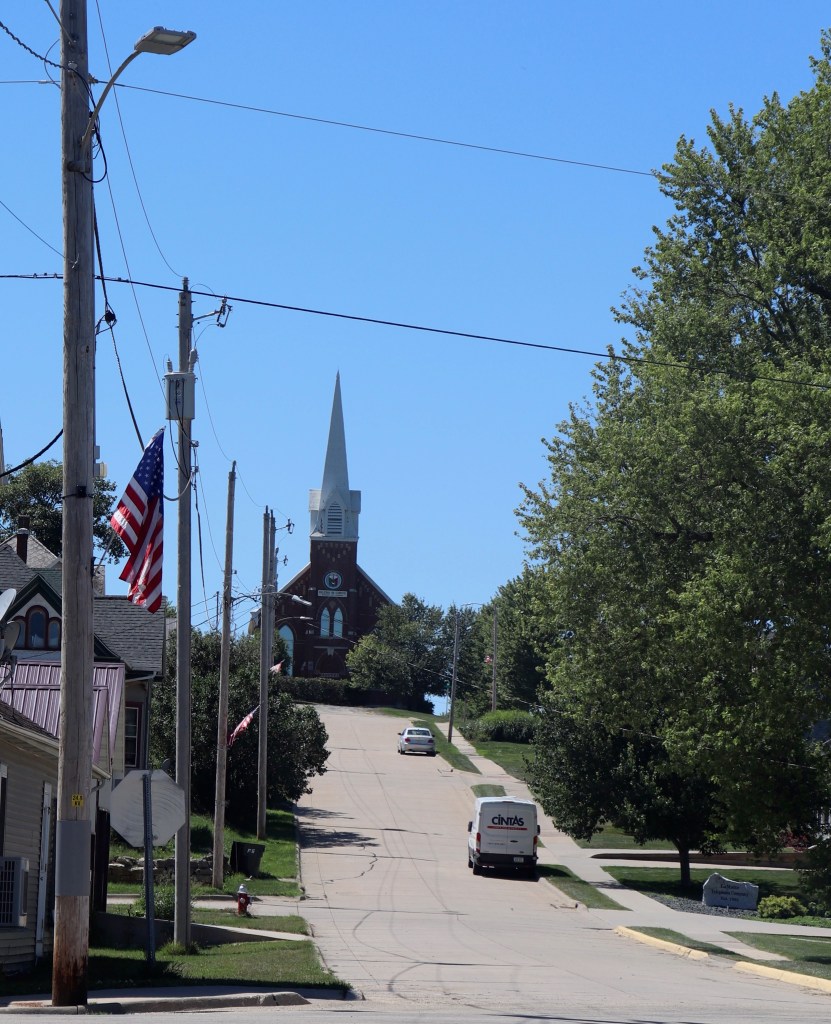
I turned left and started up the steep hill.
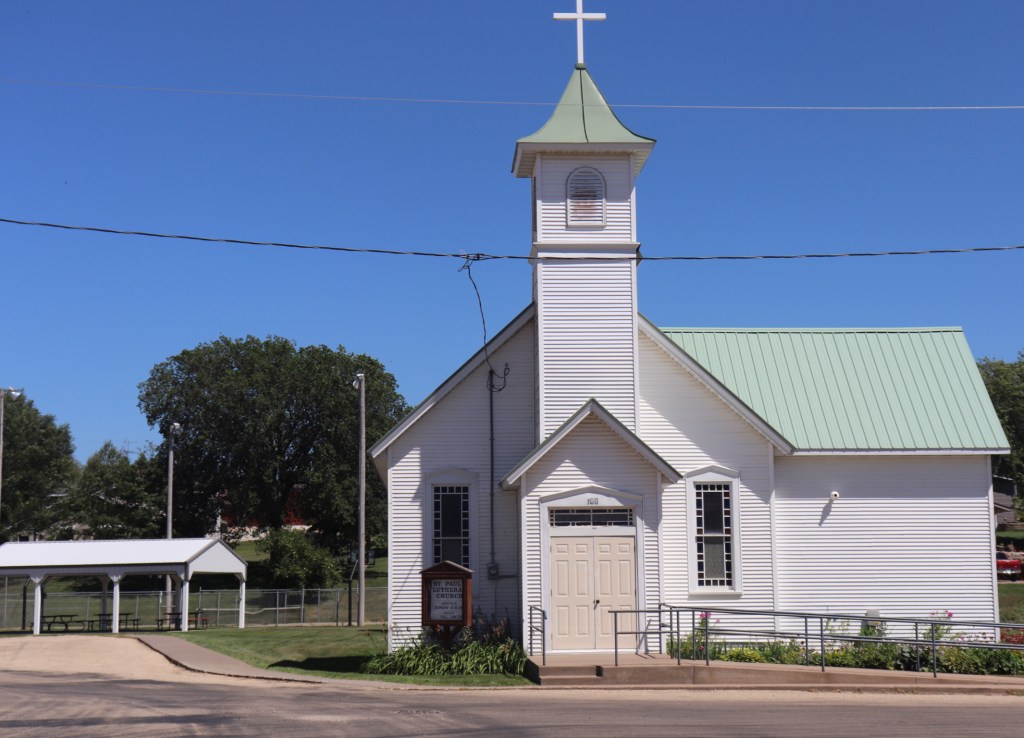
There are two churches in the town. The one straight ahead, sitting majestically atop the hill, and the smaller one in my rearview mirror, on the other side of the park. It was a town of The Catholics and The Non-Catholics. It was The Catholics who built upon the hill. No modest, unassuming structure for them, thank you kindly. The imposing brick structure had been one of five: the church, the rectory, the convent, the grade school, and the high school. The brick convent, grade school and high school were torn down years after I moved away.
The Non-Catholics, on the other hand, were satisfied with a little white, dignified wooden structure that was heated by a pot-bellied stove. Growing up, my brothers and I were never allowed to fraternize with “those other folks”. I only know about the pot-bellied stove because I peeked through a window on my brother’s dare. To this day, I still don’t know who those Non-Catholics were, where they lived or went to school.
This hill was always the best for sleigh riding. The bottom of the hill would always be closed off after a good snow so we could get our sleds out and ride safely. But I don’t think anyone really needed a sign. The adults just knew to keep their cars away from the church hill after a snowfall or they would run over a sledder. It was an okay ride if your sled stopped at Elaine’s grandmother’s house halfway down, a good ride if it stopped at Herrig’s garage as the street leveled, but a great ride if you coasted another half block to Manderscheid’s Tavern.
I was two-thirds up the hill when I turned onto my old street and stopped across from my childhood home. Anyone who ever grew up in a small town knows the stir a stranger can cause. I surely did, and there is nothing worse than an out-of-town car with somebody you don’t know sitting in it. So I parked the car and quickly shut off the engine. I didn’t want to make any noise and disturb anyone.
I sat there peering at the house, suddenly realizing that it was once a large structure chopped into two components. Funny – I never noticed that as a kid.
Our side had two rooms down, three rooms up. We never had hot running water so we always had to heat water in a big kettle on the stove. The bathroom was added when I was about four years old, but it didn’t have a bathtub, so on Saturdays Mom grabbed a huge vat, set it on the stove and filled it with water. After the water was heated, she rolled the wash tub into the kitchen, locked the door against unexpected visitors, and called each of us one by one to our bath. After we outgrew the wash tub, Mom took us to her mother’s to use her bathtub. She caught up on the family gossip while waiting for all of us to get clean.
I looked at the second floor where my old bedroom was. It was the width of a twin bed, with just enough space for one small dresser. My bedroom claimed the only closet in the house. That was okay, though. We had very few clothes to wear so we needed little storage. I wondered how long the magazine photo of Paul McCartney had stayed on the wall.
I noticed the flowerbed in the front yard was gone. That was too bad. I loved the bright orange tiger lilies. Then I began to realize how quiet everything was. No traffic, no machinery, no blasting stereos. Just the birds and leaves rustling in the breeze…kids playing… and grownups talking in their yards. “I miss this quiet,” I thought.
I was staying dangerously late and pretty soon the word would spread through town that a stranger was hanging around. I didn’t want to run into anybody from my previous life then be forced to explain to them what I was doing there, and why. I reached out for the key in the ignition.
Without warning a tribe of ruffians came racing from the back yard and around the corner of my old house, yelling, “Hurry up!” and laughing. I looked back at the yard. It wasn’t a tribe at all, only three little girls, about eight or nine years old, and certainly not ruffians. blonde, a brunette and a redhead. Unusual combination any time, but particularly for a small town. It was the brunette, though, who caught my eye, and who I watched most intently. She was the grubbiest – hair askew, knees scuffed up, tee shirt unwashed for several days from the looks of it. I found myself liking her right away. I could tell the three girls were great friends, too. Lots of deep conversations, frowns, nods, laughs, and songs. The brunette had vibrant energy, a light laugh, and what appeared to be unbounded joy. She radiated strength and curiosity. I sat there enjoying the scene until I heard women calling the girls home for dinner. The blonde and redhead raced off. The brunette opened the door and walked into my house.
I was just about to restart the car when my eyes whipped back to a sudden sound from the house.The door had slammed and the little brunette walked quickly to the corner of porch that separated the house in two. She had a blanket in her hand that she wrapped around her shoulders, then put her back against the corner, and skidded down the wall. Her little body plunked onto the porch floor. She tightened the blanket around her then drew her knees up to her chest, wrapped her arms around them and put her head down. She seemed to be crying.
Then her head moved up and she looked straight at me, as if hearing something.
We stared at each other for what seemed a very long time. Then she disappeared. And I suddenly knew the reason I had turned off the highway.
I guess it was easy to let my thoughts wander aimlessly as I sat in my car, staring at the house. It was all so quiet and safe. There had been no actual children in the yard. In my mind, visions of forgotten play times came as clearly into my sight as if it were happening for the first time, with my best friends. Redheaded Dianne and blonde Elaine had materialized right along with me. As I watched myself play, I was shocked to discover how “normal” I had been. How easily I had liked that little girl. I hadn’t felt either way when I was living it. My mom, angry at me one day when I was about six years old, sneered at me that I was bad, and no one would ever like me if they ever got to know me. My dad would mock me, humiliating what I would say to him as a joke in front of others.
Suddenly, I remembered something important that I had blocked out all these years.
I was nine years old. After spending the afternoon playing with my friends, I walked into the house and stepped right into my parents’ fight.The insults were beginning to be hurled back and forth, and I knew they would eventually target me again if I stayed. I grabbed my blanket and escaped back outside to my special corner of the porch. I put my back against the wall and slid down onto my behind. I pulled up my knees and put the blanket over them, bringing it up under my chin. I closed my eyes. I would have stayed like that, but I heard the sound of tires on the gravel street in front of my house, and I knew a car was coming. Most people walked around town instead of driving. Who could that be? Curiously, I looked up. But no car was there. And I hear, “You are going to remember this one day.” With a child’s innocent trust, I accepted it and put my head back onto my knees.
It was this car she heard. Now, today, decades later, I was learning who that little girl really was. I was simply a blameless little girl growing up abandoned by the people around her. And I liked her. I would never abandon her, ever again.
Peace flooded through me in one huge wave, settling into stillness. I stared at the empty porch corner for a few more moments before I started the ignition. Before I turned the key I paused, and glanced at the passenger seat. I knew the ghost of the little girl I had been was sitting there. She looked at me, then smiled and turned to stare straight ahead at where we were going together. I smiled to myself and started the engine.
I looked back at my childhood house one last time. I drove slowly away, saying an affectionate good-bye to it, and the town.
Many years have passed since that day in late summer when I turned and drove into my hometown. I’ve never had the urge to go back, and I don’t think much about it any more.
But once in a while, when the air is so crisp you can almost reach out and snap it in two, I grab a sweatshirt and go outside. I watch the dusk begin to settle and the sky turn that grayish color it always gets around 5:30pm on a late fall afternoon. I think of my hometown with the buildings clustered around a small park, the few hills full of homes, and trees bursting in beautiful greens or autumn oranges, reds and yellows, and the pretty depot at the end of the street past Junior’s Tavern. I smell wood burning somewhere, and look for slim spirals of smoke floating up from chimneys. I don’t notice how late it is until the ground gets so cold it freezes my bottom. Then, and only then, do I march inside to be comforted by the blast of heat from my furnace and the smell of dinner on the stove, and I smile. When I do, my happy little girl smiles right back at me.
I’m finally home…home at last.
 St. John Journals